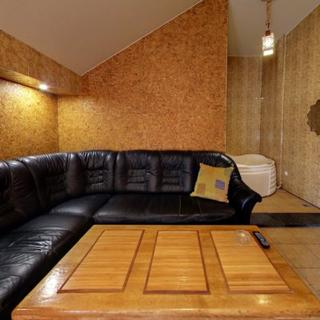
You arrive at a spa complex with a steam room, an outdoor hot tub and a swimming pool. The receptionist says, "Whatever you prefer." But the difference between the three isn't a matter of preference. Your body responds to each of them differently, and where you start and how long you stay will decide whether you leave relaxed or wrung out.
Below is what research tells us about heat treatments — and what people repeat about them without any basis. The second is more common.
The thermometer doesn't tell you the most important thing
A Finnish sauna runs at 80–100 °C, and the air is dry: humidity stays somewhere between ten and twenty percent. That's precisely why such a temperature is bearable at all — in dry air the body sheds heat efficiently.
A hammam works the other way round. A classic Turkish bath is a series of rooms at different temperatures, and the main one is around 43–46 °C with humidity approaching one hundred percent. That's more than forty degrees cooler than a Finnish sauna, and a hammam does feel gentler — though not as much as the numbers suggest: in air saturated with steam, sweat can't evaporate, so cooling works less well and the body takes on its load at a lower reading. Exactly how much gentler is a separate calculation.
An infrared cabin is a third mechanism. It heats your body directly rather than the air, at 43–57 °C. People who struggle in a steam room usually find it easier to tolerate.
One measurement shows clearly why the thermometer isn't the whole story. In 2026, at the University of Jyväskylä in Finland, fifty people each completed four ten-minute sessions at different combinations of temperature and humidity. Humidity turned out to raise heart rate independently of temperature: by roughly 0.37 beats per minute for every percentage point of humidity. Put simply, a ladle of water on the stones doesn't just make it "nicer". It means a heavier load at the same reading on the thermometer.
What happens in ten minutes
In the same study, participants' heart rate rose markedly over ten minutes in the sauna. Body temperature, meanwhile, went up only moderately, by about 0.4 °C.
A review of the evidence in Mayo Clinic Proceedings (Laukkanen and colleagues, 2018) puts it this way: the body's response to an ordinary sauna session is comparable to moderate-intensity physical activity — roughly like brisk walking.
Two practical points follow from this. First, a sauna isn't "a lie-down". If you go after a sleepless night or a long day on your feet, your body gets another workload rather than a break. Second, it isn't a substitute for exercise either. A similar heart response doesn't mean the steam room does for you what a walk does.
Three claims best left in the changing room
"You lose weight in the sauna." Your weight really does drop, and the scales will show it. But what you lose is water, not fat, and it comes back with the first glass you drink. Cleveland Clinic says so plainly: in the short term you lose water weight, and that's dehydration.
"Sweat flushes out toxins." Sweat from the sweat glands is about 99 % water; the rest is salt and traces of other substances. A 2019 review of sweat gland physiology concluded that sweating plays a negligible role in removing waste and pollutants compared with the kidneys and the gastrointestinal tract, and that studies claiming otherwise more likely had methodological problems. Detoxification is the job of the liver and kidneys — and they work in the steam room exactly as they did before you went in.
"The more you sweat, the more good it does." The amount of sweat measures how your body is cooling itself, not how much benefit you're getting. Someone who sweats twice as much has simply heated up faster.
None of this is a reason to skip the sauna. It's a reason not to go in with expectations it won't meet.
How long, how many rounds and what with
In Finnish practice the usual pattern is a round of 5–20 minutes followed by a break of 10–30 minutes outside the steam room. The break isn't a courtesy to other guests: it's when the thing you came for actually happens.
In half an hour in the sauna the body loses between half a litre and a litre and a half of fluid — a wide range that depends on temperature, humidity, body weight and how used you are to heat. So it's worth drinking before, not only after: going into the steam room already dehydrated is the quickest route to dizziness.
The two combinations that most often spoil the evening are a heavy meal before the sauna and alcohol. And separately: if you have a chronic condition, especially a cardiovascular one, the question of heat treatments is one for your doctor, not the person at reception.
Contrast: hot tub, cold plunge, pool
An outdoor hot tub is a separate treatment altogether. The heat is carried by water, there's nowhere for sweat to evaporate, and it feels entirely different from dry air. Hot tubs tend to appear where there's room for them: at venues with hot tubs they're usually set on an open terrace or in a garden — as at Chavered Manor or the Luxor recreation complex.
A cold plunge after the steam room is the part of the ritual most often presented as compulsory. A 2025 study in which participants went through three cycles of heating and cooling found that systolic blood pressure responds sensitively to repeated cycles, while heart rate between them stays stable. In other words, the contrast is a load in its own right, not just a finishing touch. You can enjoy the treatment without ice-cold water: cooling down gradually in a cool room works too.
The pool is the third option, and the calmest. It doesn't give you a sharp contrast, but it lets you move and stay in the water longer. Venues with a pool are usually hotels and complexes where you can combine it with an overnight stay, such as Aquatel Complex or Hotel Mars.
Can a sauna replace a massage after training?
You'd expect a simple answer here, but it's a different one. A 2025 systematic review brought together 14 studies on heat exposure after physical exertion — 194 participants in total. Four showed a benefit for recovery, four showed nothing, and one recorded worse performance. The authors write that no firm conclusions can be drawn from the available data, and they rate the quality of evidence as low to moderate.
The practical takeaway isn't "don't bother" but "not instead of". Heat relaxes your muscles pleasantly, and that's reason enough. But sleep, food and a rest day remain things it doesn't do.
Putting it together in one evening
If you have two or three hours, a simple sequence works: first a shorter round in the steam room to warm up, then a longer break with something to drink, then a second round, and only after that the hot tub or the pool. A massage is better at the end than at the start: on warmed-up muscles it feels different.
What you shouldn't do is try to fit everything on the price list into one evening. Three treatments in a row without breaks give you fatigue that's easy to mistake for relaxation.
Where to go from here
If you already know you're after dry heat and high temperatures, you need venues with a sauna and steam room; there are plenty of them in Lviv and the surrounding region, from city complexes to country estates. If what matters most is hot water in the open air, look at venues with hot tubs. If you'd like a long, calm day by the pool without sharp contrasts, try venues with a pool, among them Park & Hotel Aquarell and the Kopa hotel and restaurant complex.
And if you're planning a whole day, there's a separate selection of relaxation spaces and wellness complexes, where the sauna, pool and massage are all in one place, as well as Hotel & SPA Pysanka or Taurus Hotel, where you can also stay the night — so you don't have to get behind the wheel after the sauna.