It's a question people in the changing room answer confidently — and differently every time. There is a measured answer: not a prescription, but numbers from which you can work out a sensible routine yourself.
What happens in ten minutes
In a 2026 study, fifty healthy adults each completed four ten-minute sessions in an ordinary Finnish sauna, with half an hour of recovery between them. Researchers measured heart rate and body temperature.
Heart rate rose noticeably, while core temperature rose only moderately.
Classic reviews of the physiology describe it in the same way: a sauna produces a cardiovascular response similar to moderate physical exercise. That's exactly why afterwards you want to sit down rather than go for a run.
The first conclusion, from which everything else follows: ten minutes in a sauna is a workout, not a rest from one. And it should be dosed like a workout.
Why "more" doesn't work
If a session is a form of exertion, a longer session doesn't give you more rest — it gives you more exertion. The difference between twenty minutes and ten isn't that you'll "warm up better", but how long your heart works at a raised rate and how much fluid you lose.
The population data that are often cited refer to sessions of five to twenty minutes several times a week. That isn't a prescription or a promise of results — it's the range within which people usually use a sauna.
It's worth being frank: the evidence on the long-term effects of heat treatments is limited, and a short-term rise in heart rate proves nothing about them on its own. A sauna is no substitute for exercise, sleep or medical treatment.
A workable routine, if you translate the numbers into practice
A round of about ten minutes. Less if it's your first time, if the sauna is very hot, or if water is being poured on the stones.
A break between rounds at least as long as the round itself. In the study there was half an hour between sessions; in practice the guide is simple: once your breathing is calm and your pulse back to normal, you can go in again. If not, the break has been too short.
Two or three rounds. Four is the upper limit, even in a study where participants were monitored with instruments.
Between rounds, cool water or simply fresh air — not going straight back in. Cooling down is what makes the second round enjoyable.
Three adjustments for beginners, and none of them is about willpower
- The lower bench. The difference between the upper and lower benches in the same sauna is tens of degrees. It isn't "for the weak"; it's a different regime.
- No steam. A ladle of water on the stones sharply increases the strain, because humidity affects your heart rate regardless of temperature. Skip it on your first visit.
- Shorter than you'd like. Leaving while it's still pleasant is the right strategy: that way the next round will be pleasant too.
When to stop, without asking anyone
The signals are simple: you become aware of your heartbeat, you feel dizzy, the heat stops being pleasant, you no longer want to breathe deeply. Any one of them means it's time to get out, not "two more minutes".
And the reverse: feeling comfortable is no guarantee that the strain is low. You can feel fine and at the same time have a pulse like after a brisk uphill walk. That's why you count the time by the clock, not by how you feel.
A Lviv peculiarity that affects how many rounds you can do: saunas here are almost always part of a hotel or complex rather than a separate bathhouse — the selection of accommodation with a sauna has at least fifty listings, 24 of them with a full profile. So time is sold by the hour, and you have to fit three or four rounds with breaks into the slot you've booked, not "as long as you like".
Where it all fits into a relaxed evening
A routine of "two or three rounds with proper breaks" requires two things: a sauna and somewhere to cool down. They don't always come together, so it's worth checking both separately.
Accommodation with a sauna is the full list; there's also a separate one for places with a pool, where the break between rounds takes care of itself.
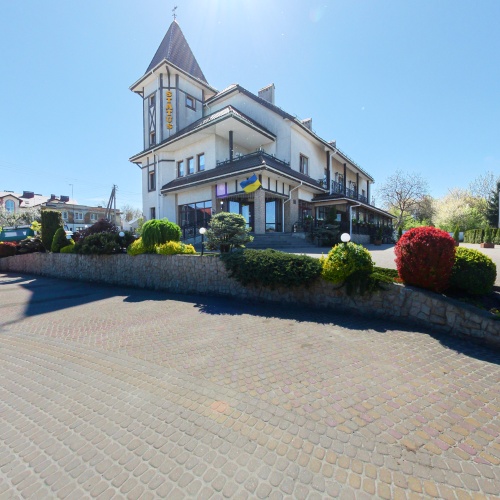
They include Olena Resort, with its distinctly spa-focused space, Status, Premier Hotel Dnister, Pysanka and Halitsiya.
One question to ask when booking that settles everything: is the sauna private, or shared according to a timetable? In the first case you set the routine; in the second, the timetable does, and two or three rounds with breaks may not fit into it.
The shortest answer
Ten minutes, a break no shorter than the round, two or three rounds, and water to drink beforehand. Everything else is about adjusting it to yourself: a lower bench, less steam, less time. There's no extra merit in sitting longer — just more strain, which you'll feel afterwards as tiredness rather than rest.