People choose a spot by a pond or a river "because it's pretty" — and that's true, but it's not the whole story. Over the past decade, the effect of water on wellbeing has been measured quite thoroughly, and the results lead to several very practical conclusions about how to choose such a place.
A million mood reports
The most convincing study on the subject was designed simply: twenty thousand people received prompts at random moments of the day and recorded where they were and how they felt. In total, more than a million responses were collected.
The result was striking: people were happiest when they were by the water — noticeably more so than in any other setting, green parks included.
Later studies went further and linked time spent near water with lower levels of stress and anxiety. Something simpler has also been established: just looking at a natural landscape produces rapid changes — in salivary cortisol, blood flow, blood pressure and brain activity. In other words, it isn't only a walk that works, but also the view from a window.
The sound of water works, but not equally for everyone
Here's an interesting detail that rarely gets mentioned.
In a study of sixty women, participants listened to ten minutes of water sounds before a stressful task, and were compared with groups who listened to calm music or to nothing. A reduced stress response did appear — but only in those with physical complaints (tension, aches, discomfort). In the music and silence groups there was no such effect at all.
The practical upshot: if you arrive at the water tired and tense, the sound of water works more strongly for you than for someone who feels fine. It's one of those rare cases where feeling worse gets you more benefit.
The main factor in whether a view works
A separate review of water soundscapes provided the most useful finding for choosing a place: the strength of the effect depends not on how loud the water is, but on four things — the character of the sound, how it varies over time, how well it fits the setting and, above all, whether what you hear matches what you see.
In practice: a table from which you can both hear and see the water works; a table from which you can only hear it works noticeably less well — the brain receives mismatched signals.
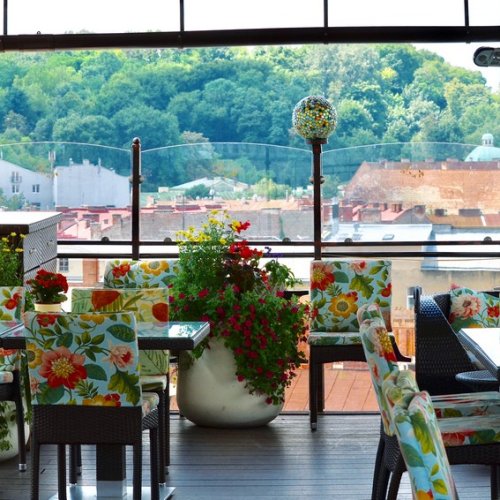
So when booking, don't just ask "do you have a water view?" — be more specific: will my table have a view of the water? At most lakeside venues there are fewer of these tables than all the others, and they're the first to go.
Three formats, and they're not equal
Dinner with a view. The most accessible option: venues by the water — ponds, rivers and lakes in and around the city. They include Navariya Nova, Chagari Restaurant & Hotel, Villa Austria, Ozero ("The Lake") and AQUARIUS Eco-Hotel-Grill-Restaurant.
A day by the water. This works better than dinner, because duration matters: the effect builds up with the time you spend in such surroundings. Fishing belongs here too — a format in which you're by the water for hours, with no agenda at all.
Water as part of your stay. Accommodation with a pool or on the waterfront — an option where the view is there in the morning too, when it's at its quietest.
What water doesn't do
It's worth saying this as well, so that expectations aren't inflated. Research on blue spaces is mostly observational: it shows an association, but doesn't prove that the water itself causes the improvement. People who spend a lot of time near water usually move more, get outdoors more often and have the time to do so — all of which also has an effect.
So the honest way to put it is: people consistently feel better by the water, and that has been measured; the mechanism isn't fully understood. For choosing where to spend an evening, that's quite enough.
One detail that spoils any view
The microclimate. By the water it's cooler and damper in the evening than in town, and the difference can be bigger than the forecast suggests. A terrace with a perfect view where you start shivering after forty minutes gives you less pleasure than a table behind glass with the same view.
So the second question to ask when booking, after "will there be a view?", is: is the terrace heated — or can you move indoors if need be?
And how many such places are there in Lviv in reality? The selection of waterside venues has 21 listings, 13 of which have their own profile. That isn't many, and in December some of the locations work differently from summer: the terraces are closed, but the view remains. So for a winter evening, the question to ask is not "is there water?" but exactly where in the room you'll be able to see it from.
In short
Water works, and that has been measured across a million responses. But it works under certain conditions: you need to be able to see and hear it at the same time, you need to spend more than twenty minutes there, and you need to be warm while you do. Three questions when booking cover all three conditions — whereas the view on its own covers none of them.