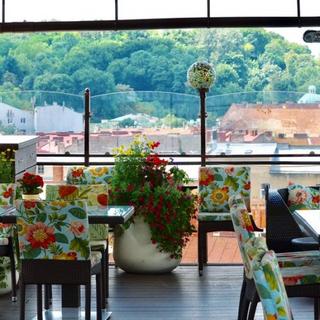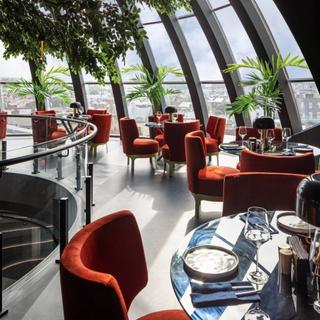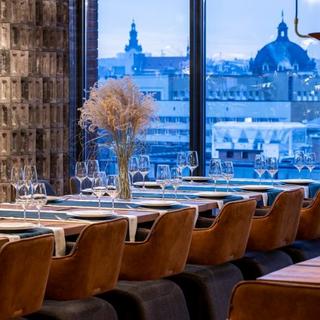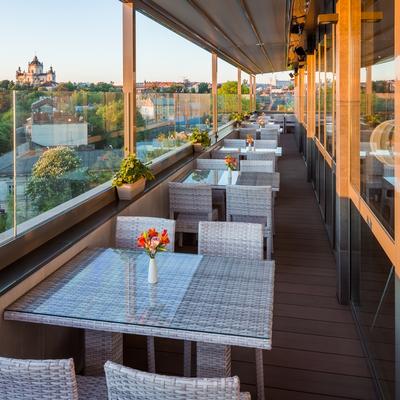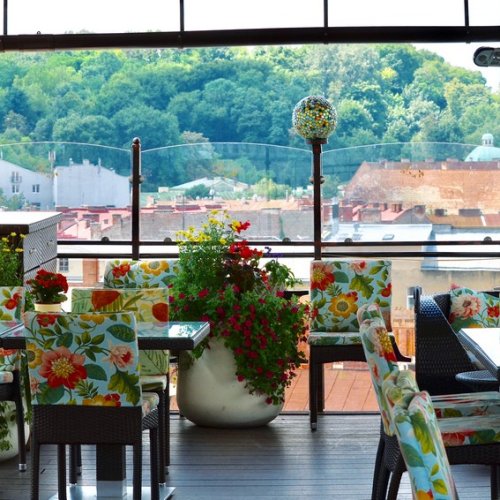
The feeling that the same dish tastes better on a rooftop has a simple, objective explanation — and it has nothing to do with the kitchen. There are also clear conditions that determine whether dinner up high is a success or a letdown.
Beautiful surroundings really do change the taste
This has been tested in two ways. First with photographs: people were shown settings of high and low aesthetic value alongside images of food. In the "beautiful" settings, the food was rated higher across all three senses at once — sight, smell and taste — and people reported more positive emotions and a greater desire to eat.
Then the same thing was tested in two real rooms with real food. The result held: in the more attractive setting, people rated the smell and taste more highly and were more likely to want to come back. Emotion turned out to be the mediator — in other words, beauty affects taste through mood rather than directly.
So "it tastes better on the terrace" isn't politeness or self-suggestion. It's a measurable effect, and it works whether or not you know about it.
Why height works more strongly than just a nice view
This is where a distinct emotion comes in, with its own body of research: awe. It's defined as a response to something new and complex on a scale unlike the everyday — a high mountain, an enormous building, a vast open space.
Several quite specific things are known about it.
It reduces everyday stress. Six studies showed that people who are prone to feeling awe more often report lower levels of daily stress — and this holds even after accounting for other positive emotions. In one experiment, participants climbed a tower about sixty metres high: after taking in the view from the top, their level of everyday worries went down. The mechanism is named explicitly — a sense of one's own scale against a vast space.
It physically slows you down. Four studies involving tall buildings recorded a "freezing" effect: after seeing images of tall structures, people felt less mobile and reacted more slowly. In other words, height really does make you slow down — physically.
It's stronger when shared. A separate study of shared awe showed that awe experienced with others has a stronger effect than the same view alone. And one more detail: looking up amplified the effect more than looking down.
A practical takeaway that hardly anyone uses: on a rooftop, look not only down at the city but also up at the sky. And don't go up there on your own.
Two numbers that decide whether the evening works
Now for the prosaic part, which is what most often ruins the loveliest plans.
Industry data on comfort on open-air terraces gives this range: most guests feel comfortable at roughly 15–24 °C. Above 29 °C, comfort drops because of the heat. And below 10 °C, some people start to feel cold even with heaters — a heater warms a spot, not the air.
The second thing, which matters just as much as temperature, is wind. On a rooftop it's always stronger than in the street below, and the forecast doesn't show that.
So there are two questions to ask when booking a table up high: is there shelter from the wind, and can you move indoors? A "yes" to both turns the evening into a reliable plan, whatever the weather.
Where to find this in Lviv
For the full list, see restaurants with rooftop terraces. They include Soprano Restaurant. Roof terrace, CLOUD no.7 Panorama, LOFT7, Valentino Restaurant and Bar Panorama in Dnister Premier Hotel.
If you want the same effect without the height, water works too: a horizontal expanse gives a sense of scale just as well as a vertical one. And ordinary restaurants with well-designed interiors provide the same "aesthetics of the setting" that influences taste.
When to skip the rooftop
If the point of the evening is a long conversation, height can work against you: the wind carries your voice away, and you both start raising your voices without noticing. For an evening of conversation, an indoor dining room is more reliable; save the rooftop for something shorter — an aperitif, the sunset, an hour and a half.
And one last thought you won't find on any menu: the effect of height is strongest in the first few minutes, when you've just stepped out and taken in the view. Don't waste those minutes — spend them not on your phone but on the sky.
In short
The aesthetics of a place change how food tastes — that has been measured — and a rooftop has a double advantage here: both beauty and scale. But it only works within a certain temperature range and when there's no wind, and it suits a long conversation less well than an ordinary dining room. The format that works: something short at sunset, as a couple or with friends, and a few minutes of looking up before you sit down at the table.