Breakfast at a café or restaurant is often seen as a matter of convenience: the same as at home, just without the cooking. In fact it's a genre of its own, with its own history, its own physiology and its own criteria for choosing a place — quite different from those for dinner.
Brunch was invented in 1895, and for a reason
The word "brunch" first appeared in print in 1895, when the British writer Guy Beringer published an essay in Hunter's Weekly with the telling title "Brunch: A Plea".
He proposed it not as a culinary idea but as a social one: a leisurely, more sociable alternative to the traditional Sunday meals. Beringer's argument was practical — by removing the need to get up early on a Sunday, brunch would make life more pleasant for those who had spent Saturday evening out with friends.
There is another account of where the late-morning meal came from: Catholics who fasted before Mass would sit down to a large midday meal afterwards. Both versions agree on one thing — this is a meal defined by time and pace, not by a particular set of dishes.
This explains why brunch can't be "done quickly at home". The whole point is that you're in no hurry; if you are, it's simply breakfast.
Why a protein breakfast keeps you full for longer
Here there is a direct measurement, and a practical one. In a study comparing protein breakfasts with a carbohydrate breakfast, the protein options significantly raised levels of GLP-1 and PYY — hormones that signal fullness — and reduced self-reported hunger.
The most interesting detail: there was no difference between plant and animal protein — not in the hormonal response, not in subjective appetite, and not in how much participants went on to eat at lunch. In other words, it's the protein itself that works, not where it comes from.
The practical takeaway for reading a menu: a breakfast of eggs, cheese, fish, pulses or nuts will keep you going longer than a croissant with the same number of calories. That isn't an argument against the croissant — it's an argument for knowing what to expect before lunch.
What we actually know about skipping breakfast
The subject is overgrown with claims, so it's worth being precise about what the research shows and what it doesn't.
A meta-analysis of studies published up to mid-2019 found that skipping breakfast is associated with a higher risk of cardiovascular disease (relative risk 1.22) and of death from all causes (1.25) compared with eating breakfast regularly. Another meta-analysis of observational studies found a link with overweight and obesity: the odds were 1.48 times higher in cross-sectional studies and 1.44 times higher in cohort studies.
And the key caveat: these are observational studies, meaning they record an association rather than prove a cause. People who eat breakfast regularly differ from those who don't in a dozen other ways — sleep patterns, work, stress levels. So the correct wording is "associated with", not "leads to".
None of this settles the choice between breakfast at home and breakfast out. What it is useful for is not believing either those who promise health from a bowl of porridge or those who say breakfast doesn't matter at all.
Why the same omelette tastes different when you eat out
There are three reasons, and none of them is about the chef.
The first is pace. At home, breakfast happens alongside other things; in a café, it is the only thing you're doing. The same food eaten with attention tastes more vivid — the same mechanism that makes a small dessert eaten slowly more satisfying than a large one eaten in a rush.
The second is that nobody has to look after themselves. Half of breakfast at home is decisions: what exactly to have, whether there's enough, and who will do the washing-up. When you eat out, all that disappears, and the attention it frees up goes to the food.
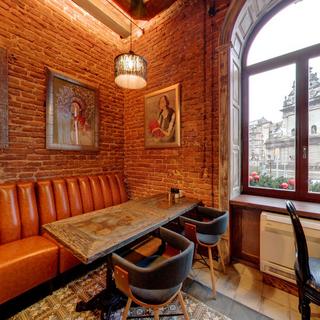
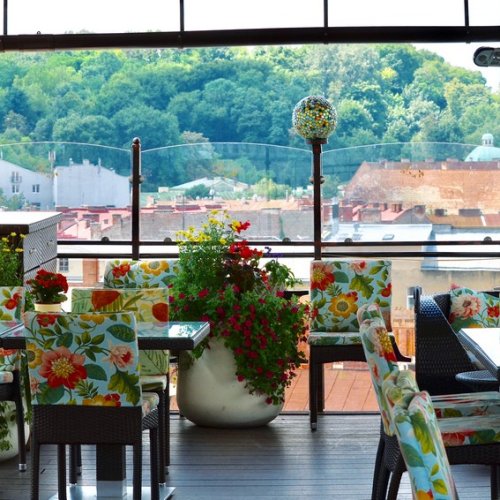
The third is light and surroundings. Breakfast by a window and breakfast in a windowless kitchen are different experiences, and this is the cheapest change you can buy.
How to choose a place for breakfast
Serving hours are the first thing to check, not the last. Most disappointments start here: you arrive at half past eleven, and the breakfast menu ended at eleven. Check this before you leave home.
Whether the menu has protein, not just pastries. If you need to last until lunch, look for eggs, cheese and fish rather than the range of sweet things.
Whether you can stay for a while. If breakfast is the event of your day, you need a place where nobody asks you to free up the table and where the noise level still lets you talk.
Whether coffee is served with the food, not before it. A small detail that decides whether this is breakfast or coffee with a snack.
There's a separate observation about Lviv here: the selection of breakfast venues is the only one we checked in which all fifty listings have a full profile of their own. By comparison, among coffee shops only six do. In other words, breakfast is exactly the format that the city's venues describe in detail: serving hours, what's on the plate, whether the kitchen is open in the morning.
Where to find it
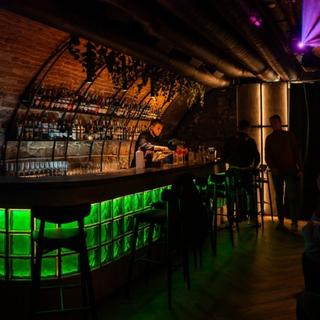
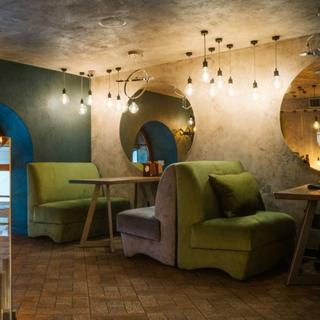
Venues serving breakfast have their own selection, and it's a large one: in Lviv, breakfast is served by restaurants, hotel restaurants and cafés alike. They include BER NAR DYN, Borshch Restaurant, Hash Rest & Bar, Shlyakhtych, Warszawa Restaurant and Tutti.
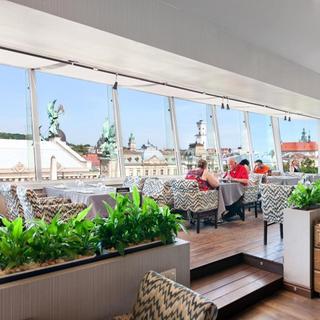
If you'd like breakfast with a view, Panorama Restaurant and Vezha Panorama Bar specialise in exactly that; if you're staying in the city and don't want to go looking, Hotel Nota Bene serves breakfast on site.
And if what you want is not food but a quiet morning coffee, that's a different selection — cafés and coffee shops — and the criteria there are quite different.