You open a menu, see the word "Mediterranean" and already picture olive oil, light fish and the feeling of having made the right choice. Science did much to build that image, and the fate of that science is more interesting than any promotional leaflet. Look closely and there's no single such cuisine anyway. There's Valencia, Andalusia, Greece and what those places actually fed people.
Where the word came from
International fame arrived in the 1960s with the American scientist Ancel Keys and his Seven Countries Study. Keys noticed the long-lived people of southern Italy and suggested the secret lay in a diet low in animal fat. He reported that among 12 thousand men examined, the people of Crete had the fewest heart problems.
The study itself grew out of a quarrel. At a WHO meeting in Geneva in 1955, two epidemiologists took Keys's arguments apart, and it was largely in response that he set about comparing countries. The criticism did nothing to dim his fame. In 2013 UNESCO added the Mediterranean diet to its list of intangible heritage, and it did so as a cultural phenomenon.
The study that was retracted
The loudest evidence in its favour is the Spanish PREDIMED trial. In 2013 it was reported that among 7,447 high-risk participants, those following this diet with added olive oil or nuts had 30% fewer cardiovascular events.
In June 2018 the journal retracted the paper and printed a corrected version. Some participants turned out to have been assigned improperly: family members were added to some without randomisation, and at one centre entire clinics received a single diet. The authors recalculated the results, including without 1,588 people whose groups might have been wrongly determined. The effect didn't vanish, and neither did the questions: critics pointed out that one measure accounted for most of the difference, and that the study had been stopped early.
You won't find a recipe for health here. What follows is about lunch, which, as we'll see, is much older than the statistics.
Paella: rabbit required, lemon optional
Paella comes from Valencia, where it's considered a symbol of the region. The name is traced to the Latin patella, a pan. As a dish in its modern form it can be followed back to the early or mid-19th century, in the countryside around the Albufera lagoon. The first mentions of rice cooked in a paella date from the 18th century, and the prettier stories about earlier times remain just that.
The Valencia tourist board gives the canon: chicken, rabbit, fresh green beans, garrofó beans, tomato, paprika, saffron and rosemary. Snails or artichokes are often added. As for garlic and lemon, the same board honestly notes that opinions are divided. The seafood version is legitimate too, but it has a name of its own: paella de marisco.
Gazpacho, older than the tomato
Tomatoes reached Spain only after the discovery of the Americas, and Andalusian labourers were eating a cold soup of bread, oil and garlic before that. This gazpacho was white. It seems a small detail until you realise that Europe's best-known red soup went without the red for a long time.
Its roots are still disputed. Some trace it to the Romans, others to the Arabs, and the word itself is derived either from the Latin caspa, small pieces, or from an Arabic expression for soaked bread. The white version survives as ajoblanco, made with almonds.
Moussaka with an author, souvlaki without one
Greek moussaka has an almost documented date. According to Wikipedia, the modern béchamel layer was created in the 1920s by Nikolaos Tselementes, a Western-trained chef and cookbook author. Similar dishes of fried aubergine and meat had been made in the Eastern Mediterranean for centuries, and the word itself arrived through Ottoman Turkish from Arabic.
Souvlaki, on the other hand, really is ancient. The word is a diminutive of souvla, a spit. A stand for spits dated to the 17th century BC has been found on Santorini, and Homer describes meat on a spit. The dish's ancestor is thousands of years older than the Ottoman era.
What to order
Greek salad. Tomatoes, cucumbers, onion, olives and feta.
Gyros. Meat from a vertical spit, wrapped in pitta.
Tzatziki. Yoghurt with cucumber and garlic.
Tapas. The Spanish way of eating from small plates.
Jamón. Cured Spanish ham.
Sangria. Wine with fruit.
Bouillabaisse. A fish soup from Provence.
Where to try it in Lviv
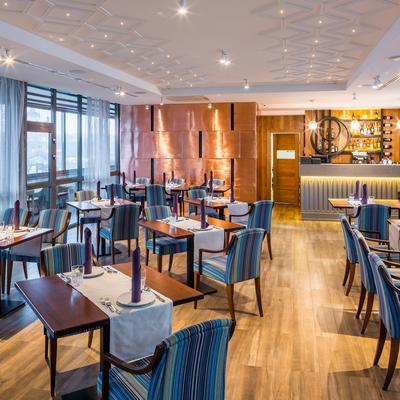
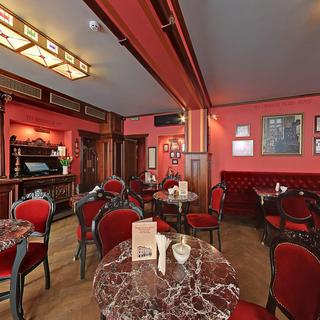
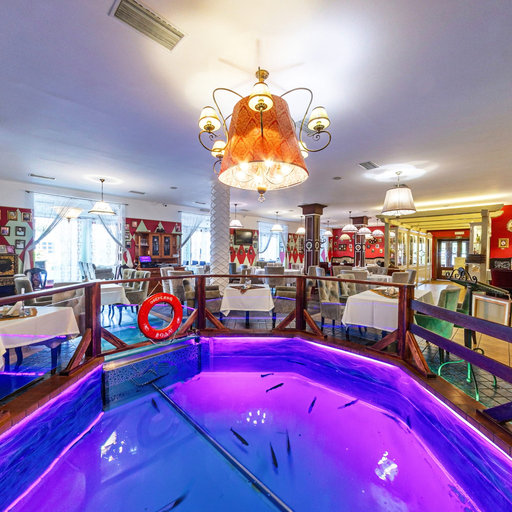
The full list of places is in our selection of Mediterranean restaurants. Look for Spanish paella at Amadeus. Chicken souvlaki is served at Soprano. Roof terrace. And Spanish gazpacho is on offer at the Ionov family's pastry shop Under the Golden Star.
The word "Mediterranean" promises one cuisine, and every plate honestly tells you which shore it's from.
Menus change, so a dish mentioned here may no longer be available. If it's the reason you're going, it's best to call ahead.