Almost everyone finds two familiar items on a Thai menu: pad thai and tom yum. It looks as if the world simply took to them. In fact each has a state institution behind it, and the first also had a prime minister with a very specific plan.
Noodles as a matter of state
The technique itself isn't Thai. Wok frying and noodles came from China, and the first such dishes in the country were probably cooked by migrants from Guangdong province. Some vendors served them on a banana leaf and wrapped them in newspaper.
Then politics stepped in. Plaek Phibunsongkhram, the authoritarian prime minister who ran the country for most of the period between 1938 and 1957, changed the name Siam to Thailand and set about creating a single national culture. Columnist Alexandra Greeley writes that one of his steps was a national dish: noodles with egg, bean sprouts and peanuts, all of which could be bought from local farmers or grown in a kitchen garden. Hence the name, which means stir-fried noodles Thai style. That's the most widely told version, although the historian Chatichai Muksong counts three theories of the dish's origin.
So that's its pedigree: a Chinese pan and a government circular. Curiously, according to guidebooks, Thais more often eat a different dish day to day, and we'll come to it below.
Cooks with a state diploma
The second government project launched in 2002 under the name Global Thai. Its aim was stated bluntly: more Thai restaurants abroad. The Ministry of Labour trained people to cook, buy and store food, and taught them basic English as well. The Ministry of Commerce studied tastes in target countries and commissioned recipes to suit them. There was even a Thai Select certificate.
One study of the policy gives these figures: around 5,500 Thai restaurants abroad in 2002 and more than 10,000 over the following ten years. The count comes from academic material, so it's best read as an order of magnitude.
Thai cuisine travelled the world partly as foreign policy, and that takes nothing away from the flavour.
A soup with a passport
On 3 December 2024, in Asunción, UNESCO added tom yum kung to its Representative List of intangible heritage. What it recorded wasn't a recipe as such: Thailand's foreign ministry statement speaks of the culinary wisdom of the river communities of the Central Plain. Lemongrass, galangal and makrut lime leaves give this hot and sour prawn soup an aroma that's hard to mistake for anything else.
Flavours are shared by the table
Thai cooking rests on a balance of hot, sweet, sour, salty and bitter. A traditional dish usually has one slightly more prominent flavour with three or four layers beneath it. Saltiness comes mostly from fish sauce and soy sauce rather than salt.
More important is that balance is also sought across all the dishes on the table. A hot curry is served beside something milder, such as a salad. The Portuguese brought chillies only in the 16th century, and according to popular accounts their heat was later softened with coconut and fresh herbs.
The practical conclusion is simple. Order one hot dish and finish it alone, and you'll taste half the idea. Shared between two, with rice and something fresh, it comes closer to how this food was conceived. And if the smell of fermented fish puts you off, ask in advance, because many sauces lose their foundation without it.
Dishes to know
Tom yum kung. Hot and sour soup with prawns and lemongrass.
Pad thai. Rice noodles with egg, bean sprouts, tofu or prawns, peanuts and lime.
Pad krapao. Stir-fried mince with holy basil, garlic and chilli, on rice with an egg on top. According to guidebooks, this is what locals eat most often.
Som tam. A green papaya salad from Isan. Som means sour and tam means to pound: the ingredients really are beaten with a pestle to release their aroma.
Massaman. A mild coconut curry with meat, potatoes and peanuts.
Green curry. A hot coconut curry on a paste of fresh chillies and herbs.
Gaeng hang lay. A northern pork belly curry with ginger and tamarind, Burmese in origin and made without coconut milk.
Mango sticky rice. Ripe mango with sticky rice in lightly salted coconut cream. It's at its best in season, from March to June.
Thai tea. Strong black tea with milk and ice.
A curry with "Muslim" in its name
Massaman stands out for its spices: cardamom, cinnamon, cloves, cumin and nutmeg are uncommon in other Thai curries. The name is traced to an archaic form of the word for Muslim, and mid-19th-century records do mention "mussulman curry". Pork is a rarity here, for obvious reasons.
That's where the solid ground ends. One version has Persian merchants bringing the dish in the 17th century. Another, backed by the chef and Thai food expert David Thompson, traces it to the Muslim communities of the Ayutthaya kingdom. An article in a Thai academic journal dates the roots of the paste as far back as the 13th century. Nobody knows who's right, and this is one case where the word "origin" is best put in quotation marks.
Don't ask for chopsticks
In Thailand chopsticks are used only for noodles, often Chinese in origin. Everyday food is eaten with a spoon in the right hand, while a fork in the left merely pushes food onto the spoon and never reaches the mouth. Sticky rice from the north is taken with the fingers of the right hand, squeezed and used to scoop up sauce.
Where to try it in Lviv
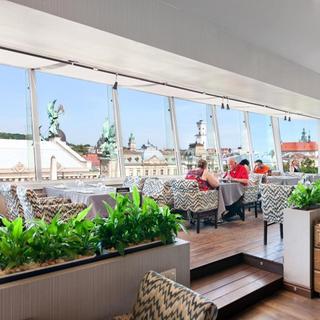
Lviv doesn't have many purely Thai restaurants, so start with the broader selection of Asian restaurants and then look for individual dishes. Szkocka lists among its soups the tom yum kung whose culture UNESCO has inscribed, and Panorama makes tom yum thale with coconut milk. If you fancy a curry, the Black Cat Pub & Restaurant has a Thai Coconut Curry with prawns, shiitake and rice noodles.
Behind one and the same bowl stand a river village and an official with a plan.
Menus change, so a dish mentioned here may no longer be available. If it's the reason you're going, it's best to call ahead.