In the run-up to the holidays, the figure "five extra kilos" comes up so often that nobody questions it any more. The measured figure turned out to be roughly four times smaller — which is good news. The bad news lies close by, and it gets talked about far less.
People gain less than everyone thinks
A research team at the US National Institutes of Health weighed participants before and after the holiday season. The average gain was 0.8 pounds — about 360 grams.
The most interesting part of the study isn't even that figure but the gap between measurement and perception: participants believed they had put on about four times more than the scales showed.
So the pre-holiday worry that "I'll ruin everything again" overestimates the scale many times over. A single evening at the table can't do what it's blamed for — in either direction.
Now the unpleasant part: it doesn't come off
This is where the good news ends. In a study that kept following the same people, there was no further change in weight between winter and early autumn — a gain of 0.21 kg turned out to be statistically insignificant. What was gained over the holidays simply stayed.
Body composition changed too: from the start of the holiday season to its end, body fat rose from 25.9 % to 27.0 %, and fat mass from 18.3 to 19.1 kg, both changes being significant. Lean mass, meanwhile, stayed the same.
The real conclusion isn't about a single evening: a few hundred grams a year never go away and simply accumulate.
What alcohol actually does at the table
One of the mechanisms has been measured separately and fairly precisely. A meta-analysis of twelve studies compared how much people eat when they drink alcohol versus a non-alcoholic drink, with or without calories.
The difference came to 343 kilojoules — roughly eighty kilocalories of extra food, on top of the calories in the drink itself. The confidence interval is wide (161–525 kJ), so the size of the effect varies, but its direction is consistent.
It's also worth knowing that the effect depends on what it's compared with and on the dose. This isn't "a glass of wine = overeating", but a statistical tendency across a group.
Why a five-hour feast is a different story from dinner
An ordinary dinner lasts an hour or an hour and a half. A New Year table goes on for five hours or more, and that brings two mechanisms into play that an ordinary dinner simply doesn't have.
The first is the delayed signal. It takes about twenty minutes for your brain to register that you're full. Over an ordinary dinner that leads to one misjudgement; over five hours of constant access to the table it leads to a dozen in a row, because each new dish begins before the signal from the previous one has arrived.
The second is the time of day. In a large observational study, every hour by which the midpoint of a person's daily eating shifted later was associated with 2.2 % higher body weight in the long term. And in a four-week experiment, evening meals worsened glucose tolerance by about 15 %.
In these studies, "late eating" means eating after nine in the evening or within two to three hours of going to bed, if that meal accounts for at least a quarter of the day's calories. A New Year table fits this definition perfectly.
That's no reason to cancel the celebration. It simply explains why the first of January feels the way it does — and why it's down not to how much you ate, but to when.
What this means in practice
Pace matters more than what's on the table. Twenty minutes between trips to the table is the only way to let the signal catch up with the food.
Don't serve the main course at three in the morning. If it arrives after two, it will be eaten on top of everything else, because by then nobody remembers feeling full.
Variety makes you eat more. The more different flavours there are on the table, the later satiety sets in — each new taste feels like a fresh start.
Breaks are a matter of format, not willpower. A dance, stepping outside or moving to another room do more for the pace than any resolution to "eat half".
And most importantly. If holiday weight gain is around three hundred grams and doesn't come off on its own, what matters is what you do from the second of January onwards. One evening decides nothing — and that applies to both of the fears it tends to provoke.
Where in Lviv this is easier to arrange
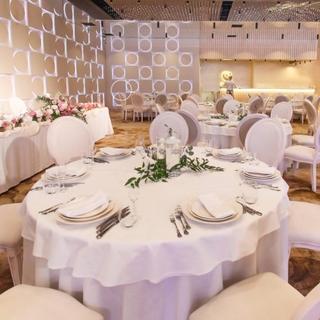
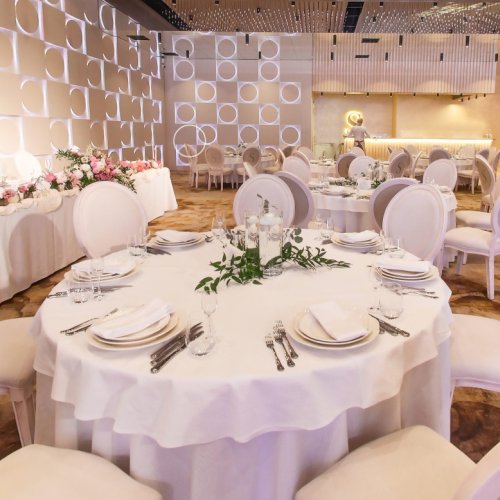
For a long evening, the table matters less than being able to leave it. Banquet halls with a space of their own offer exactly that: Svyatoslav, Europe or Eco AQUARIUS, where there's somewhere to move to between courses.
If you're planning to stay the night — and for New Year's Eve that's the most relaxed option — look at hotels with their own restaurant: Hotel Status or Hotel Irena. Then the questions of "who's driving" and "when do we go home" disappear together, and your room is just two floors up.
For those who care more about what's on the table, there's a separate selection of Ukrainian cuisine venues: in the Galician (western Ukrainian) tradition, a festive table is built around a few dishes rather than twenty — and for a long evening that turns out to be the more comfortable option.
And if there's one number worth remembering from all of the above, it's twenty minutes. Everything else follows from it.