Write down a wish, burn the paper, drop the ash into your glass, slip a banknote under the tablecloth. Half the party does it with a wink, the other half just in case, and everyone knows it isn't magic. What's more interesting is something else: research shows that a ritual really does change the outcome, and through an entirely tangible mechanism. Just not the one people are counting on.
Rituals reduce anxiety — and that's exactly why they work
The researchers tested this in a straightforward way. Participants were told they were about to sing in front of other people — a classic situation that sends almost anyone's pulse racing. Some of them were given a short sequence of actions to perform beforehand, which was described as a ritual.
Those who performed the ritual did better, and the researchers named the mechanism outright: it improved performance by reducing anxiety. Not through inspiration or belief in success, but because the person stopped worrying quite so much.
The same studies mention two more measured effects: lower blood pressure and less anxiety in situations where plenty of it would be expected.
Even an invented ritual works — and that's the most interesting part
There's a key detail without which the previous paragraph is easy to misread: in these studies, the rituals were made up by the researchers. No tradition, no history, no promised power. Just a sequence of movements put together for the experiment — and it worked.
A parallel from medicine is even more striking. There's a line of research known as open-label placebo: patients are told honestly that the pill contains no active ingredient, and they know it. In several randomised trials, each with more than sixty participants, people still reported relief from their symptoms.
So a ritual doesn't need you to believe in it to be effective. It isn't a case of "it works if you believe"; it's about the structure of the action itself: when there's something to do, uncertainty shrinks. And less uncertainty means less anxiety.
What really happens to New Year's resolutions
Now to the most popular New Year ritual of all — the promise you make to yourself. Here the figures are harsh and well known.
An analysis of around 800 million workouts logged in a fitness app produced a forecast: almost 80 % of people who make a New Year's resolution will abandon it by 19 January.
Longer-term observations show a gradual drop-off: after a week, around 71–77 % are still sticking to it; after three to four weeks, 64 %; after three months, 50 %; after six months, 46 %. After two years, 19 % are still going.
Why a resolution is still worth making
And now for the part that usually gets lost when these numbers are retold.
The same study compared two groups: people who made a New Year's resolution, and people who wanted to change the same thing but didn't make one. Six months on, 4 % of the second group had achieved their goal. In the first group, it was 46 %.
So the popular claim that "New Year's resolutions don't work" is flawed in its very logic. They do often fail to last until February — and yet they produce more than ten times better results than an honest intention without the ritual. The right comparison isn't with an ideal, but with what would have happened otherwise.
It has also been observed that success depends on wording: resolutions phrased as "I'll start doing X" last better than "I'll stop doing Y".
Where the line is — and it's worth saying out loud
A ritual acts on the person who performs it, and it works through their state of mind. These studies show no mechanism for influencing external events — money, someone else's feelings, the year ahead — and there can't be one.
So a banknote under the tablecloth won't boost your income, and a written wish won't change anyone else's decision. But an evening with its own sequence of actions really does go more calmly — and that's not a metaphor, it's a measured effect.
How to turn this into festive fun
A shared ritual works better than a solo one — simply because it also brings people together in one activity.
Inventing your own is perfectly legitimate. If even a ritual put together by researchers has an effect, then a family one made up this year is no worse than an ancient one.
Structure matters more than content: a sequence, repetition, a beginning and an end. That's what relieves anxiety, not the symbolism of the objects.
Write resolutions in positive form, and ideally make them specific: "I'll go swimming on Tuesdays" rather than "I'll do more exercise".
And don't hide your paper wishes from yourselves: a ritual everyone has forgotten by the next day has nowhere to take effect.
Where to go for an evening like this
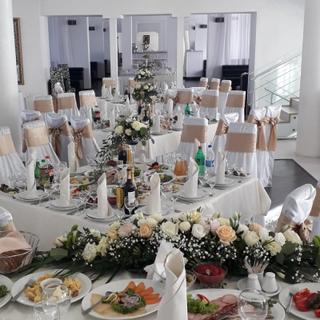
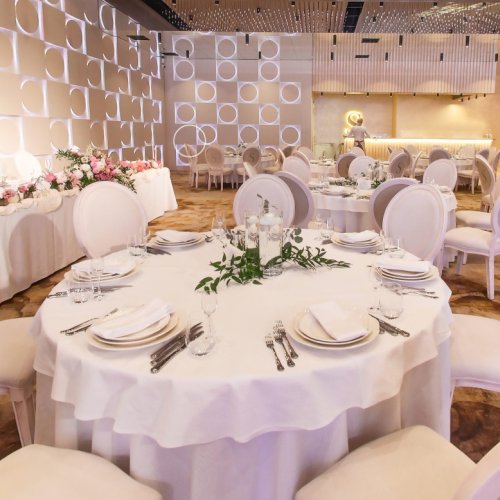
For a group that wants both a feast and something to do together, the simplest choice is a venue with a private banquet space — such as Hungry Nicholas Restaurant or Villa Austria: there you can run the evening your own way without glancing at the next table.
If your group likes an evening to have a storyline, choose a place that already has one: Amadeus, with its musical theme, or Lvivarnia, Museum of Brewing, where the building itself becomes part of the evening. The rest of the places with their own programme are listed separately.
And when the group is small and all you need is a warm place for a few hours, a café will do, or a trip out of town — to Sobieski Hotel & Restaurant in Zhovkva, for example: the journey there works rather well as a ritual in its own right.
A conclusion that won't spoil the celebration: rituals really do work — on us, not on circumstances. Which, if you think about it, is far more useful.