As the year draws to a close, parties promising a chance to "meet new people" start popping up: shared tables, a programme, a host. Some go with exactly that in mind; others hesitate, because the last such evening ended with everyone dancing side by side and then going their separate ways. The difference between those two outcomes has been measured — and it has nothing to do with the people.
How much time a new friendship takes
Researchers at the University of Kansas calculated how many hours people need to spend together for a relationship to move to the next level. The figures turned out higher than most people expect.
For an acquaintance to become a casual friend, an adult needs on average 94 hours together. To go from casual friend to friend takes roughly another 164 hours. Reaching close friendship adds up to about 200 hours in total. For students the thresholds are lower (43, 57 and around 119 hours respectively) — simply because they share more time by default.
But the key point of the study isn't the numbers themselves, it's the condition: what counts is time spent together on purpose. Shared plans, going out together, an arranged meeting. Chance conversations at the office or in the coffee queue barely count at all.
This makes it clear what a single party can't do: it won't create a friendship. Four hours is roughly a twentieth of the way to even the first threshold. What it can offer is a way in — someone you'll later have a reason to see again. A party after which nobody arranged to meet anyone hasn't failed; it simply ended in the first hour out of a hundred.
The real obstacle to meeting people isn't shyness — it's noise
Now for what most often ruins the evening.
In a survey of people who go to clubs and concert venues, around three quarters said they would like the volume to be lower than is usual in such places. The gap between the "typical" and the "preferred" level was large and consistent in both groups. People described typical club volume as a level at which conversation is possible only with considerable difficulty, and the preferred one as a level at which you can actually talk.
The researchers also suggest an unpleasant side effect: in an overly loud venue people drink faster, because conversation is physically impossible and having a drink becomes almost the only thing left to do.
In a separate review of why people avoid noisy events, the first reason given is a simple one: "it's too hard to hear the conversation".
So a party designed for meeting people and loud music make a combination that works against itself. The sound that keeps the dance floor busy also switches off the one tool you need to get to know someone.
Loneliness is common — and that's worth knowing too
In case this seems like a niche concern: according to a Europe-wide survey, 13 % of adults feel lonely most or all of the time, and more than a third feel lonely at least sometimes. Around 18 % are socially isolated (meaning few contacts, not just the feeling).
A further observation from the same data: spending more than two hours a day on social media is associated with a markedly higher rate of loneliness.
This is a correlation, not a proven cause: it may be that lonely people spend more time online rather than the other way round. But it does point quite clearly to where solutions should be sought.
What a party looks like when people arrange to meet again
A shared activity, not just a shared space. People bond not over being in the same room but over doing the same thing — a game, singing, a workshop, cooking. It gives you something to talk about without having to invent it.
A flexible format instead of fixed seating. When everyone stays in assigned seats all evening, the circle of conversation is set from the first minute. A buffet, several zones and breaks all give people a chance to mix.
Conversation works in threes and fours. A larger group inevitably splits up, and that's fine. A venue with several smaller areas works better for meeting people than one big hall.
A quiet corner is a must. Even at a loud event there should be somewhere you can hear the person you're talking to. That's where the thing everyone came for actually happens.
A reason to meet again matters more than the evening itself. A club built around a shared interest, a regular game night, a course — anything that repeats. Otherwise those ninety-four hours will never add up.
Where to look for an evening like this in Lviv
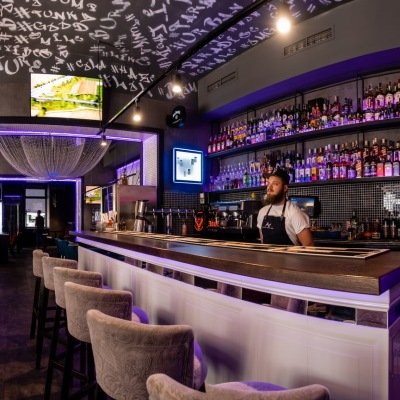
The easiest way to get a shared activity is to choose a place where it's built in. That means karaoke venues: singing together brings a group closer even when not everyone takes the mic. Options in the catalogue include BarB.Q., the Art Hall night club and the Vezha Panorama Bar.
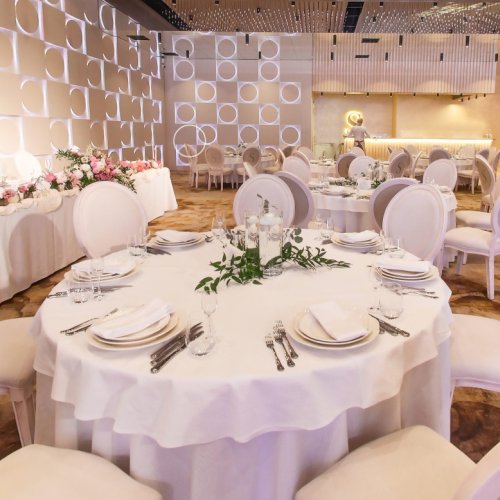
If you'd rather have an evening of conversation than a programme, look at venues with several dining rooms and moderate noise levels, such as Bachevski Restaurant or Hrushevsky Restaurant. There the evening revolves around the table and the people, which is exactly the setting in which contacts get exchanged.
A wider choice of places with their own programme can be found under entertainment and leisure, and the rest of the city's restaurants are listed separately.
And the main thing to keep in mind when you go to a party like this: the goal of the evening isn't to find a friend, but to find a reason to meet again. Those ninety-four hours will take care of the rest.