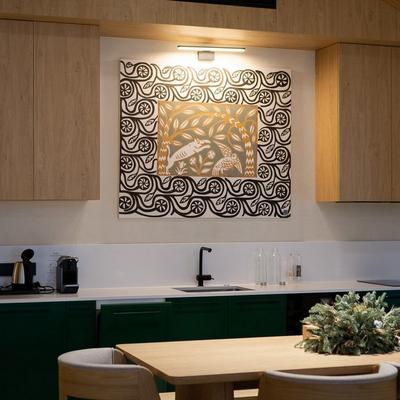
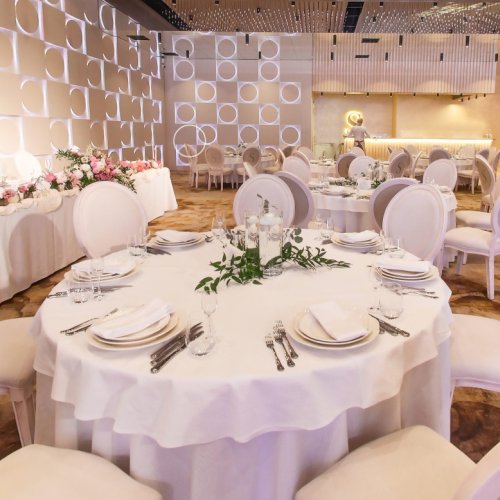
The choice between celebrating "at home" and "somewhere else" is usually framed as a choice between cheaper and more expensive. In reality, you're comparing work, travel and sleep. Those are what decide how the first morning of the year will feel.
Below is what going out actually gives you, what it costs, and which circumstances settle the question faster than any comparison of venues.
Who's working tonight
Celebrating at home has one feature that makes it hard to assess honestly: its cost is spread over the weeks before and the day after. The shopping, the cooking, the cleaning before guests arrive, the washing-up in the middle of the night, the kitchen on 1 January. None of this appears on a bill — and usually it isn't part of the comparison either.
Going out simply removes this part. It doesn't reduce it; it removes it: nobody cooks, nobody mopped the floor the day before, nobody is standing at the sink at three in the morning.
So the first question is simple: which of us is working tonight, and did they agree to it?
Work that never appears on any bill
There are figures on how this work is shared out — although they're from abroad; we couldn't find a Ukrainian survey specifically about the holidays, and it's worth saying so plainly.
An American time-use survey for 2019 found that, on average, women spent about two hours and ten minutes a day on cooking and cleaning, compared with about an hour and twenty-three minutes for men. A 2021 poll about the biggest family holiday of the year in the same country found that forty-eight per cent of women said they did most or all of the holiday cooking, while twenty-five per cent of men said the same of themselves.
The figures aren't ours and nor are the traditions, but every measurement of this kind points the same way, and it's unlikely that Lviv kitchens on 31 December run by different rules.
If there's someone in your family for whom a celebration at home means a shift in the kitchen, "going out" means the one evening of the year without that shift. So ask them first.
Switching off: the one thing home does worst
Psychological research on recovery describes four components that make rest work: detachment from your everyday tasks, relaxation, control over what happens and when, and enjoyment.
Home covers three of the four, and covers them well. Control is entirely yours: your own music, your own timing, your own guest list. Relaxation comes more easily in your own space. Enjoyment depends on the company, not the walls.
But home almost never gives you detachment, and the reason is mechanical: you stay in the place where all your tasks are waiting. The same kitchen, the same laptop on the same table, the same pile you meant to sort out. The celebration is under way, but your surroundings are telling you you're at work.
That's why a change of place does more than the distance suggests. None of your tasks are waiting in a hotel twenty minutes from home, and even a perfectly laid table in your own living room can't match that. Look for options among hotels with their own restaurant, such as Premier Hotel Dnister or PANORAMA Lviv Hotel.
Pets, children and getting home: three things that decide faster than the menu
These three factors settle the question on their own, without any comparisons.
Getting home. What most often spoils the first morning of the year is what comes after dinner. If someone's driving, their evening is different from the outset. If you don't have a car, getting a taxi at three in the morning on New Year's night is hard. A format that includes an overnight stay removes this problem entirely; so does a dinner within walking distance of home — an underrated option.
Children. The question isn't whether they'll enjoy it but where they'll sleep when they stop enjoying it. Home wins easily here. Of the options away from home, only those with a bed solve this.
Pets. Setting off fireworks and firecrackers is banned in Ukraine — and for several years now, New Year's Eve has been much quieter for animals than it was before the ban. Before the bans, fear of fireworks was widespread and well documented: in a survey of more than sixteen hundred animals in New Zealand, forty-six per cent showed fear noticeable to their owners. A British study added a detail about how this is measured: when asked in general terms "is your dog fearful?", about a quarter of owners reported fear, but when asked about specific signs in their dog's behaviour, almost half did.
The share depends on how you ask, but the order of magnitude is the same: roughly every second dog had a hard time on that night. Now what matters is who's there: who stays with the animal if the family goes away, and how much longer than usual it will be left alone. Settle this before you book.
What home does better than any venue
For the comparison to be fair, here's the other side.
Home gives you unlimited time: a venue closes at a certain hour, your living room doesn't. It gives you your own guest list, with no minimum spend and no neighbouring tables. It gives you the freedom to step away from the party without leaving the house: somewhere unfamiliar, a person who's tired at one in the morning has nowhere to go. And it gives you familiar food — which, for some families, matters more than cooking of any calibre.
There's one more thing that's rarely mentioned: at home you can celebrate without a script. On this night, many venues have an entertainment programme, and it assumes you'll take part. For some groups that's the whole point of the celebration; for others it's the worst part.
In-between options: going out without the organising
Between "everything at home" and "a big party in a banquet hall" there are several options that take the main benefit of going out — not having to do the work — without adding any organising.
A long dinner close to home. One table, one group, no programme. Restaurants that cater for banquets usually take smaller tables too: try Lviv Outskirts Restaurant or Knyazhyy Dvir Restaurant.
A night away without travelling. A hotel in your own city: dinner, a lift, breakfast. No journey, no cleaning up, and yet a complete change of scene.
A few days out of town. Here New Year's Eve stops being an event and becomes part of your stay. Leisure resorts in the Lviv region such as Vezha Vedmezha Hotel or Panorama Skhidnytsa SPA Resort work exactly like this. One nuance from research on holidays: their benefits hardly depend on how long they last — so here three days are valuable above all for the change of routine.
What to ask when booking — and one question to ask yourself
They'll tell you about the programme and the menu themselves. It's worth asking about the things that usually go unmentioned, and all of these questions are about logistics.
What time does the venue close, and what happens afterwards? Is there somewhere to get away from the music? Can we bring children, and where can they sleep? How will you get home, and is that already sorted? Are pets allowed, if it's a few days out of town?
And one last step worth taking before you book. Write down everything that has to be done by hand that night: buying, cooking, laying the table, washing up, tidying, driving people there, driving them back. Put a name next to each item. If one name appears on most of the lines, you already know who should be celebrating away from home this year — and you don't need any other comparisons.
A word on timing, too: research shows that looking forward to an event lifts people's wellbeing before the event itself — people who are anticipating a trip rate their lives more highly overall than those who aren't going anywhere. A decision made in November works for you all through December. One made on 28 December doesn't work at all.