When grandparents, parents and children gather around one table, most of the preparation goes into the menu: something light, something festive, something the kids will eat. Then the evening falls flat, and nobody can quite say why. More often than not the reason is mundane, measurable in units and printed in the small type of no listing anywhere: the room was simply too loud.
Seventy-seven decibels is an average restaurant, not a bad one
Noise levels in restaurants have been measured many times, and the figures tend to agree.
An analysis of more than 1,300 restaurants in New York found an average of 77 decibels — roughly a vacuum cleaner running in the room. A quarter of the venues went above 81 dB, the point at which diners have to raise their voices. In a separate study of thirty venues in another city, levels ranged from 58 to 97 dB, and only 23 % were quiet enough (up to 60 dB) to talk in a normal voice.
For comparison, an ordinary conversation at arm's length is about 60 dB. In other words, a typical dining room is two to four times louder than the voice of someone speaking in it.
The US Environmental Protection Agency puts the threshold plainly: people with normal hearing start to struggle to follow a conversation above 75 dBA.
For older guests, the same figure means something else
Now for the point of this article. A study of speech intelligibility in restaurants among people over 60 — with and without hearing loss — found a clear limit: for an older person to understand the person they're talking to without straining their voice, background noise needs to be below 50 dB.
The gap between 50 and 77 sounds small, but on a logarithmic scale it's a different world. And the most important finding of that study lies elsewhere: in the group with moderate to severe hearing loss, intelligibility was only about 50 % even at minimal noise of 35 dB, with the other person speaking normally from a metre away.
So a grandmother at a festive table in an ordinary dining room isn't failing to hear "because of her age". She can't hear because the room physically won't let her — and no amount of "speak up" will fix it, because a louder voice in a loud room only pushes the overall level higher.
The flip side has been measured too: in a survey about noisy venues, around eight in ten people admitted they had left a restaurant or bar because of the noise, and 91 % said they would not go back to such a place.
Dining rooms have got louder — and the numbers show it
A detail for anyone who feels that "it used to be quieter": you're not imagining it.
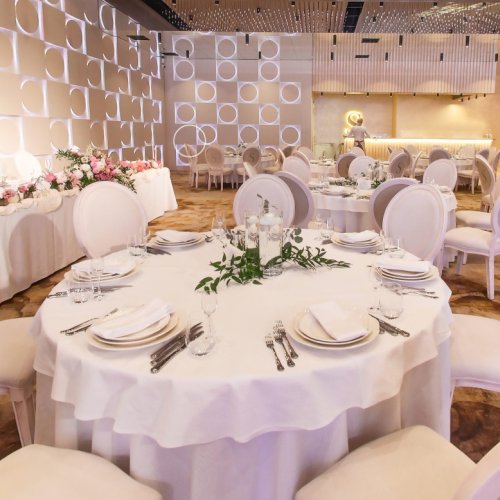
In an older study of restaurant noise, peaks stayed within the range of normal conversation. A quarter of a century later, the average across a large sample was already 77. The change isn't accidental: open kitchens, hard surfaces, minimal textiles and background music all belong to modern interior design, and each of them adds sound.
This leads to a counterintuitive conclusion: the newer and more fashionable the room, the more likely it is to be loud. An old-school restaurant with heavy curtains, tablecloths and carpet may look less striking in photos, but it wins on how well you can hear each other.
And a local factor worth bearing in mind when booking in Lviv: the city's catalogue lists at least fifty venues with live music — as many as there are restaurants in the largest selection, because both lists return results in batches of fifty. So you're quite likely to end up in exactly that kind of place, and whether there will be live music on 31 December is worth asking separately from the menu.
What research says about generations spending time together
Lest it seem that this is all about difficulties, there's another side to it, and it comes with numbers too.
A survey of 246 children aged 11–12 found that 82.9 % of them spend some leisure time with their grandparents, mostly in person rather than online. The most common activity was "going somewhere for a bite to eat" (76 % of answers). Those who spent time with their grandparents face to face reported higher overall life satisfaction (4.49 versus 4.12) and well-being (4.15 versus 3.82), and the difference was statistically significant.
So a family meal out is neither a formality nor a duty owed to the older generation. It's the very activity the youngsters themselves name most often, and it is measurably linked to how they feel.
How to plan a table like this
A private room matters more than the menu. A separate space removes most of the background noise, and it's the first thing to ask about — before the dishes.
Skip the live music or save it for the second half of the evening. For a three-generation gathering, it eats up exactly what everyone came for.
Timing matters. The same dining room sounds different at six in the evening and at nine. If you have older relatives and small children with you, an early start makes more difference than the choice of venue.
Real conversation works in groups of four at most. At a table for twelve, talk will split into smaller groups anyway — so the seating plan is no trifle: a grandchild sitting next to their grandmother will talk to her; one across the table won't.
Children need a way to leave the table. Not entertainment laid on by the venue, but the chance to get up and go somewhere for half an hour — a corridor, a courtyard, a separate room.
Where to go in Lviv
For a large family, the safest option is a place with a private banquet space, where the room — and the sound — is yours. Within the city, options include the Kopa hotel and restaurant complex, Argo and Taurus.
When there really are a lot of you and you're staying for several days, an out-of-town complex works better: there's room to spread out and somewhere for the children to go. Among the options in the catalogue are Chavered Manor and Ozerny Kray.
As for the selection of venues with live music, keep it to hand for the opposite reason: so you know where not to book an evening when it matters that the older generation can hear.
And one last thing to take away: at a family celebration, the most valuable part is what people say to each other. Anything that gets in the way of that costs more than any menu.