Many people believe they rest better in a hotel than at home: fresh sheets, nobody to wake you, nothing to do in the morning. Sleep research says the opposite — which is exactly why it's worth knowing about before you book.
In an unfamiliar place, people sleep on average 20–30 minutes less, and less deeply. This is known as the first-night effect, and it has been confirmed by dozens of studies. A 2022 meta-analysis of 53 papers showed that on the first night it takes longer to fall asleep and more time is spent awake.
The good news is that most of this can be anticipated and partly offset. And almost everything that helps comes down to the particular room, not the number of stars on the facade.
Half of your brain stays on guard
The mechanism behind the first-night effect is now understood fairly precisely. A neuroimaging study showed that in a new place the two hemispheres of the brain don't sleep equally deeply: one stays "on watch" and monitors the surroundings. What matters more in practice is that this lighter-sleeping hemisphere reacts more strongly to unfamiliar sounds: they wake you more often and trigger a faster response than the same sounds reaching the "calm" hemisphere.
This leads to a practical point that few people consider when booking: in a hotel you wake up to sounds you simply wouldn't hear at home. The same car under the window, the same lift, the same neighbour in the corridor would pass you by at home. That's why soundproofing in a hotel room matters more than in your own bedroom — not because hotels are noisier, but because you're more sensitive to sound there.
Researchers at the University of Fribourg also tested whether the effect wears off: participants slept in a laboratory twice, a week apart. Poor sleep onset recurred even on non-consecutive nights — in other words, one familiar night a week earlier doesn't make a place feel like "yours". The effect is stronger in children, teenagers and older people; people in their twenties feel it least.
If you're staying for one night, don't count on "catching up on sleep at the hotel" — instead, choose a room where nothing unnecessary will disturb you. If you're staying three or four nights, the second and subsequent nights will be normal, and then the comfort of the bed comes to the fore.
The mattress: medium-firm, not "orthopaedic"
This is one of the rare cases where research gives a fairly clear answer. A systematic review concludes that medium-firm mattresses consistently outperform both very hard and very soft ones: they distribute pressure better, give higher-quality sleep and less stiffness in the morning.
The most telling evidence is a randomised double-blind trial of 313 adults with chronic back pain: after 90 days, those who slept on a medium-firm mattress had noticeably better scores for pain in bed, pain on getting up and everyday disability than those who slept on a firm one.
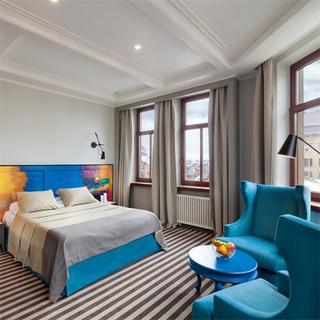
For hotels this means something simple: a "firm orthopaedic mattress" in the room description isn't an advantage — at best it's a neutral detail. A bed that sags noticeably, however, is a reason to ask for another room.
Air: the figure no room description mentions
The least obvious factor in sleep is ventilation. A field study in 29 bedrooms (participants weren't told when the ventilation setting was changed) found that with lower ventilation people had less deep sleep, more light sleep and more awakenings. In the bedrooms where the difference in CO₂ concentration was pronounced, deep sleep was significantly reduced.
The benchmarks are these: if CO₂ in the bedroom stays below 750–800 ppm, the air doesn't affect sleep; from 1,000 ppm sleep is already disrupted; at 2,600 ppm the following day suffers too, with poorer attention and logical reasoning. An open window fixes this. An open door to the corridor doesn't — that was tested separately.
The practical upshot for choosing a room: a window that opens and working ventilation matter more than floor space. A small room with fresh air will give you better sleep than a spacious one with sealed windows and an air conditioner that just recirculates the same air.
Stars: what they really mean
Official classification isn't a marketing badge. The European Hotelstars system assesses a hotel against roughly 239 criteria: reception and service, rooms and bathrooms, food, wellness, and transparency online. Audits are carried out on site, periodically, by independent inspectors.
It's worth knowing that the stars shown on some booking platforms are not part of this system — they are the platform's own labels and can mean anything.
And the main limitation to bear in mind: classification describes the presence of things — a lift, a safe, housekeeping, reception hours. It says nothing about quiet, the quality of the mattress, ventilation or which way the windows face. In other words, the very things your sleep depends on are not what the stars promise.
How to check before you book
The first thing to do is look at the whole room, not just at carefully chosen shots. A photographer shoots from the most flattering angle; places with a 3D tour let you walk around the room yourself and see what doesn't make it into photos: the distance between the bed and the wall, what the window looks out on, whether there's space for a suitcase, what the bathroom is like. It's the only way to get a sense of proportions without being there.
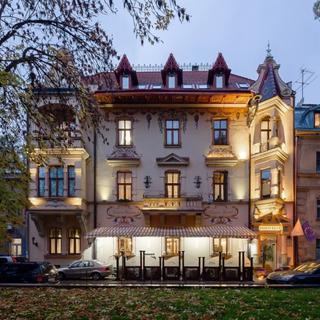
The second is to decide what matters most for this particular trip. For one working night near the station or the centre, a city hotel will do: Hotel Suputnyk, Swiss Hotel, Atlas DeLuxe Hotel, Premier Hotel Dnister or PANORAMA Lviv Hotel — all of them, and some thirty more, are in the selection of hotels in Lviv.
The third is to factor in the length of your stay. If you're staying for a week, the first-night effect wears off by the second night, and everyday practicalities take over: your own kitchen, a washing machine, not having to go out for breakfast. That's a job for serviced apartments and aparthotels — say, the Modern Properties apartment on Doroshenka Street. If the point of the trip is rest rather than the city, look at recreation complexes: Ozerny Kray Hotel & Resort or Park & Hotel Aquarell, where quiet comes with the location itself.
And one last tip, small but effective: if you know the first night is going to be a poor one, don't schedule anything important for the morning after you arrive. It's cheaper than paying extra for a quieter room, and more reliable.
Where breakfast is included, that's one less decision to make in the morning — hotels with breakfast are listed separately. And Chopin Boutique Hotel is an example of a place where the restaurant and your room are under one roof, so after a journey you don't have to go anywhere.