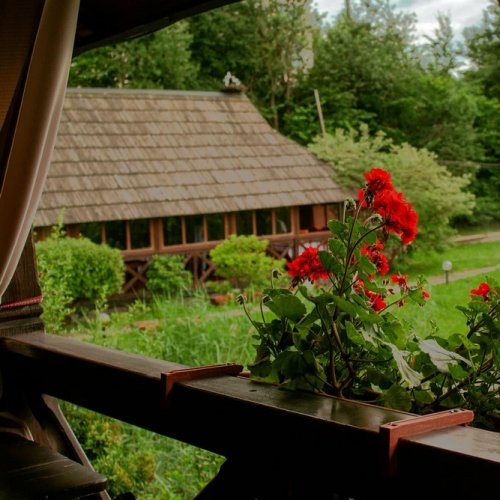
People usually start deciding where to celebrate by picking a place: someone suggests a restaurant, someone else a country retreat, another a karaoke bar. But there's a question worth answering first, because it rules out half the options straight away: how many people need to have a good time.
Below are the two numbers that any such decision passes through, and what they mean for groups of different sizes.
The first number: four
In a conversation, we can keep track of the thoughts, feelings and intentions of roughly four people at once, ourselves included. That's a limit of attention, not of good manners.
This is why observations of real meals give such a consistent picture: the average group at lunch and dinner is about 3.3 and 3.6 people respectively — practically the same as the average size of a freely formed conversation group.
What this means in practice is that one big shared conversation inevitably breaks up into smaller ones. Sociologists call this schisming, and it isn't a sign that the party is failing — it's the natural state of any group larger than four or five. The trouble starts when the space doesn't allow for it: one long table, one toast, one loud soundtrack for everybody, and nowhere to step aside for a chat.
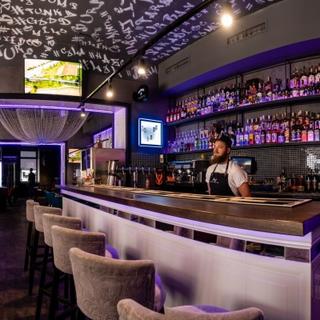
For a group of ten or more, the most important thing about a venue isn't the table but having a second area: a lounge, a terrace, a separate corner, even just a bar. It lets people regroup naturally.
The second number: 1.3–2 square metres per person
For banquet seating, the industry standard is 1.3 to 2.0 m² per guest. For a layout with more open space and room to move around, it's 2.0 to 2.5 m².
The calculation is simple: divide the floor area by the standard. But before you divide, subtract whatever space is already taken: room for a DJ or musicians, partitions, speakers, bars, and a dance floor if you need one.
So "a room for 80" and "a 100 m² room" are two different statements, and the second is more useful. If a listing only gives the number of seats, it's worth asking what seating layout that figure assumes and whether it includes space for dancing.
Round tables or one long table?
This isn't a question of style — it has a practical answer.
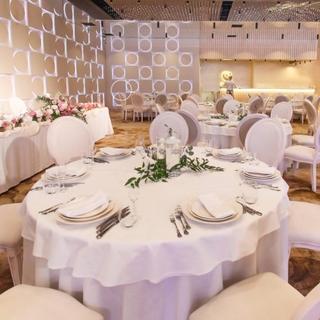
A round table keeps everyone in one conversation: everyone can see everyone else, the whole table hears the toast, and the group doesn't split up. It works for small groups — and when guests don't know each other well and need something in common to talk about.
A long rectangular table, by contrast, creates "pockets" — local conversations of three or four people. For a large group where everyone knows each other, that's an advantage, not a drawback.
A simple rule of thumb follows: seat a group of up to eight at a round table, and a group of twenty or more at a long table or several round ones with space to move between them — not at one enormous table where half the guests can't hear the other half.
Three group sizes, three different tasks
Up to ten people. You don't need a private room, and it can even work against you: in a big empty space a small group sounds lost. A restaurant where you can book a table in a quieter part of the dining room is enough. What matters here is the food and whether you can actually talk — not whether there's a stage.
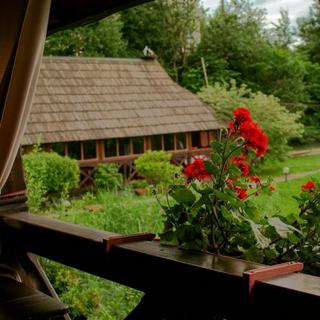
Ten to seventy. From around twenty guests, a private room starts to make sense. What to look for: a second area so people can regroup; a separate entrance, or at least a separate route to the room, so guests don't have to walk through the main restaurant; and its own sound system, so the music can be turned down for toasts. Banquet halls in Lviv cater to exactly this segment: Hutsulska Grazhda, Gostinna Khata, Valentino, Svyatoslav and Art Hall.
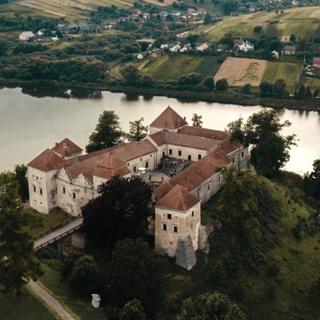
Seventy and up. At this point the question becomes one of logistics: parking, a cloakroom, the number of toilets, how quickly food can be served to everyone at once, and whether the venue has experience with events of this kind. Benketnyy Dim, Capital or unconventional spaces such as the banqueting venue at Svirzh Castle work at exactly this scale. The full list of places that host banquets is in the selection of venues offering banquet service.
What a venue listing won't tell you
Five things worth asking before you book, because they're hard to sort out after the fact:
Is there another hall in the same building, and will there be a party there on the same evening? Sound travels through walls better than you'd think. Can you bring your own cake, and is there a charge for it? What time does the venue close, and what happens if your group wants to stay longer? Where will guests park if there are thirty of them? And is there somewhere to step out with a child or take a phone call?
Where to start
If your group is small and the food matters most, choose from restaurants — for example, Amadeus in the city centre. If there are more than twenty of you, start with banquet halls and ask for the floor area in square metres straight away, rather than the number of seats.
And the most useful test of all: count how many people you want to say more to over the evening than "Hi, thanks for coming." If it's fewer than ten, you need a table, not a hall. If it's more, you don't need a bigger table — you need a space where you can move from one group to another.