It's the question everyone asks when looking at country resorts: why drive an hour when there's a sauna and a pool two blocks away? The answer isn't that "nature is good for you" — you could say that about anything. The answer lies in a few specific measurements, and they're more about duration than distance.
Two hours a week
The largest study on the subject covered 20,000 people: a team led by Mathew White at the European Centre for Environment and Human Health (University of Exeter) found that people who spend two hours a week in green spaces — local parks or other natural settings — are significantly more likely to report good health and psychological wellbeing than those who don't.
The key detail in this finding — and the most practical one — is that those two hours can be clocked up in one go or over several visits. In other words, you don't need a week away for the effect to appear; what counts is the total time.
The first practical takeaway: if you spend half an hour in a park four times a week, you're already over that threshold. But if your week is spent shuttling between home and the office, a weekend in the countryside is the simplest way to get the full two hours in one go.
What exactly is measured when rest is measured
The physiological side has been studied, but it's worth knowing to what extent.
Time in green spaces is linked to lower levels of cortisol, the main stress hormone; heart rate and blood pressure usually fall along with it. A meta-analysis confirms that exposure to natural environments can lower cortisol — the biological marker of stress that is studied most often.
And here an honest caveat is needed, one the researchers themselves are the first to make: results from subjective measures of stress are more consistent than those from physiological ones. That is, the fact that people feel less tense after time in nature has been recorded more reliably than specific changes in test results. This doesn't make the effect imaginary — it means that science can't yet give precise figures for how much stress levels drop.
There are narrower measurements too: a study of a short forest programme for children with chronic conditions recorded a significant drop in salivary cortisol and alpha-amylase immediately afterwards. This is specifically a short-term effect — and for a weekend, that's enough; nobody promised more.
Why "a park nearby" and "getting away" aren't the same thing
One interesting separate finding: the amount of green space within one to three kilometres of home correlates with how people rate their own general health. So your surroundings work not only as a place you visit but also as the backdrop you live in.
This leads to something less obvious. If you have a park right outside your window, you already have part of what people leave the city for — and then a trip away isn't about greenery but about something else: quiet, having nothing to do, being somewhere you won't be reminded of the washing-up. But if you live in an area with little greenery, getting away fills that very gap, and then it works more strongly.
Three kinds of getaway, each with a different purpose
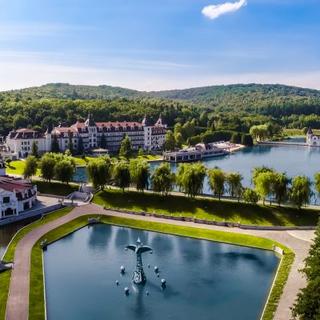
A resort with a pool and sauna — the closest and most predictable option. It's not far to drive, everything is on site, and there's no need to plan anything. It suits you when the main thing is to break your routine for a day or two. Country resorts in the Lviv region include Ozerny Kray Hotel & Resort, Park & Hotel Aquarell, Shepilska Resort Complex, Hotel Sherwood and Chavered Manor.
Heading for the mountains — a longer journey with a different purpose: what matters here isn't the resort but what surrounds it. Hotel Zakhar Berkut and Panorama Skhidnytsa SPA Resort work exactly this way: you're not arriving at a hotel, you're arriving at a place.
A country house or a small property for your group — for when who you're with matters more than what's around you. The Vezha Vedmezha castle hotel or Edem Resort Medical & SPA are examples of a place itself setting the tone of the weekend.
If it's mainly about the steam room and the water, there are narrower selections: out-of-town venues with a sauna and with a pool. The full list of accommodation outside the city is under hotels in the Lviv region.
The biggest mistake people make with a weekend away
It isn't about choosing the place but about the arithmetic of time. Two hours' drive there and two back take four hours out of your two free days, a noticeable chunk of one of them — and if you arrive on Saturday afternoon and leave on Sunday after lunch, you're left with just one evening of actual rest.
So the practical rule is simple: either go somewhere closer for one night, or further afield for at least two. The in-between option — far away for one night — gives you the least of all for the greatest cost.
And second: it's best not to plan a schedule for the trip. What people go to the countryside for is described in research as the absence of demands on their time — and a weekend planned hour by hour is the first thing to strip that away.