Charcoal, a grill rack, meat — it could hardly be simpler. Yet this is where the gap between what people do and what actually happens to the food is widest. Three processes determine the result, and all three can be controlled.
Process one: browning starts only once the water has evaporated
The brown crust, the aroma and the grill marks all come from the Maillard reaction: the transformation of proteins and sugars under high heat.
The key detail that almost everyone overlooks: as long as there is moisture on the surface, the reaction doesn't begin. The water has to evaporate first, and only then does browning start. And evaporation draws heat away — so a wet surface doesn't just delay the crust, it actually cools itself down.
In practice: patting the meat dry with kitchen paper before it goes on the grill does more than any marinade. Wet meat doesn't sear on a grill; it stews in its own juices, and the crust forms too late, when the inside is already dried out.
It's the same reason not to put everything on the grill at once: cold, wet food drags the temperature down, and the rest of the batch cooks differently from the first pieces.
Process two: smoke isn't just a "smell" — it's three groups of compounds
The smoky flavour that makes grilling so popular has a well-documented composition. Wood smoke, produced by combustion at roughly 300 to 500 °C, contains three families of compounds:
- phenolic compounds (guaiacol, syringol, eugenol) — these provide the "smoky" note itself;
- organic acids (acetic, propionic) — they add flavour and act as a natural preservative;
- carbonyl compounds and furans — these give toasted, caramelised and woody notes.
That's why the type of wood genuinely changes the flavour, not just the atmosphere: different woods produce these groups in different proportions. And it's also why an electric grill, however hot, can't deliver the same result — it lacks the third ingredient.
Process three: the one worth knowing about, without panic
When food is cooked over high heat, some of the proteins can turn into heterocyclic amines. And when fat and juices drip onto the coals, they produce smoke containing polycyclic aromatic hydrocarbons, which settles back onto the food.
Now for the part that usually gets lost in conversations about health risks. Most of the research on these substances has been done on animals, with doses thousands of times higher than anything a person would consume. There are no large studies convincingly linking them to cancer in humans. Saying that grilled food raises your risk isn't accurate.
The practical takeaways, without alarmism:
- less fat means less dripping and less smoke: leaner cuts and trimming off excess fat reduce both groups of substances;
- vegetables produce neither at all, because they don't contain the relevant protein;
- marinating and cutting off charred bits are simple and sufficient precautions.
Four things that set restaurant grilling apart from a backyard barbecue
Temperature. A professional grill holds steady, high heat; a home barbecue fluctuates, which is why at home one batch turns out perfect and the next doesn't.
Indirect heat. Thick cuts are finished not over the coals but to one side of them, in a zone without direct heat. At home, people rarely set up that zone.
Resting. Meat taken off the grill needs to rest before it's sliced: in that time the juices redistribute and stay in the meat rather than ending up on the board. A few minutes of waiting makes a more noticeable difference than changing the temperature.
Extracting the smoke. Outdoors, smoke rises and drifts away; in an enclosed space it settles back on the food, and the flavour becomes heavy.
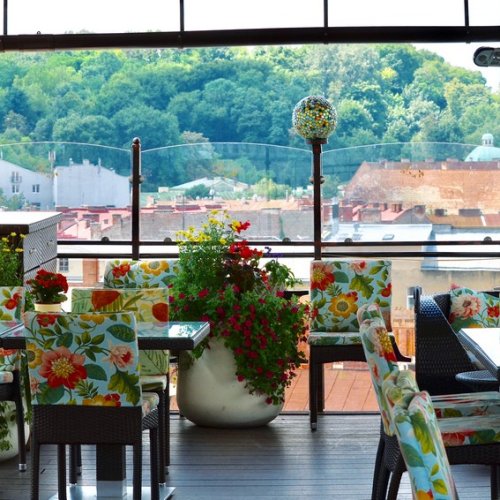
In Lviv, this area is better covered than any other cuisine: the selection of venues with a grill includes at least fifty listings and 46 dedicated profiles — more than any other cuisine selection we've measured. So there's a genuine choice, and you can ask about charcoal, wood or gas in advance.
Where they'll do it for you
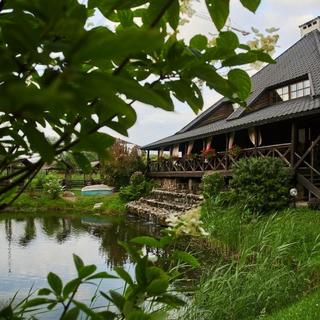
The widest choice is the selection of venues with grill and barbecue: mostly complexes and restaurants with a dedicated grilling area rather than a barbecue in the yard. Among them are Hutsulska Grazhda, Eco AQUARIUS Grill, Sviatoslav, Gostinna Khata and Malevich.
For a group, look at venues offering banquet service, and for a whole day out, at holiday complexes in the Lviv region, where the grill is usually part of the grounds rather than a separate service.
In short
Pat the surface dry, don't put everything on at once, get rid of the smoke and let the meat rest. Four steps, none of which requires special charcoal or skill — and together they make more of a difference than everything else people usually argue about over the barbecue.