When an evening falls flat, each of the three gets the blame in turn: the food was mediocre, the music too loud, the place had no vibe. Research into restaurant atmosphere has been going on for half a century, and it assigns the roles in a rather unexpected way. The key point is that atmosphere affects something other than what we tend to assume.
The effect of music is real but small — and it's worth knowing exactly how small
Let's start with the size of the effect, because that's what usually gets overestimated.
A meta-analysis of studies on how background music affects food intake found an overall effect size of 0.19, with a confidence interval from −0.003 to 0.386 and p = 0.054. In plain language: the effect exists, it's small, and it sits right at the edge of statistical significance.
In other words, music can't rescue an evening that has gone wrong for other reasons. All those stories about "the right playlist that changes everything" describe an influence that, on average, is barely distinguishable from zero.
As for drinks: some studies have found that loud music increases how much people drink, including alcohol, but other research hasn't confirmed this. The question is still open, and it's too early to present it as fact.
What atmosphere reliably changes is something else: your behaviour
Now for what has been measured with much more confidence.
Music tempo changes how long you stay. In one experiment, guests spent the most time in a dining room with slow music, less with the control condition, and left soonest when the music was fast. There was also an interesting detail: in the fast-tempo group, tips were higher than in the control group.
Tempo also changes how fast you eat. In separate experiments, a slower tempo made meals last longer, and a smooth sound without sharp attacks extended them further still — but only when the tempo was slow.
Lighting changes taste. In a study where the same yoghurt was served under different lighting, people rated it as sweeter under bright light.
Put all this together and you get a division of roles that runs against intuition: the food decides whether you enjoyed it; the atmosphere decides how long you stay and how much you order. These are separate questions, and confusing them is the main mistake people make when choosing a venue.
Why the second matters more on New Year's Eve
For an ordinary dinner of an hour and a half, the division hardly matters: the food counts for more, and that's that.
But a New Year's Eve celebration lasts five or six hours, and here the main question is no longer "is it tasty?" but can you stand being there for six hours? That's exactly what atmosphere determines, in a technical sense: volume, tempo, lighting, how many people there are per square metre, and whether there's somewhere to step out to.
So on 31 December the order is reversed. Good food is enough; the atmosphere has to be chosen to suit the length of the night.
How to check before you book
Visit the same venue on an ordinary evening. It's the most accurate method, and it's free. The volume, lighting and tempo will be different on the big night, but the space, the seating and the acoustics will stay the same.
Ask specific questions about the music: who's playing, at what times, and whether there will be a break. "Live music" tells you nothing — it can mean anything from a duo to a full band.
Check whether there's somewhere to step out. Over six hours this matters more than the menu: a corridor, a courtyard, a second room, a terrace.
Find out how many people there will be. The same room sounds very different with forty guests and with a hundred and forty, and that isn't a matter of taste.
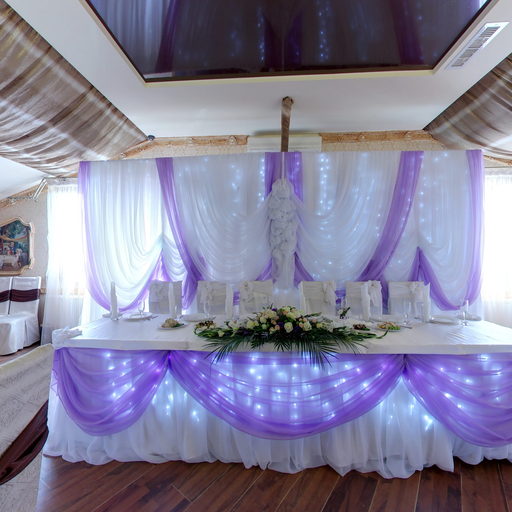
Lighting. If there will be photos — and on 31 December there always are — look at how the place appears in the evening, not in the daytime photos in its listing.
Where in Lviv atmosphere is the main draw
The city has categories of venues where the space itself is part of the evening, and for a long night these are the ones that hold up over six hours.
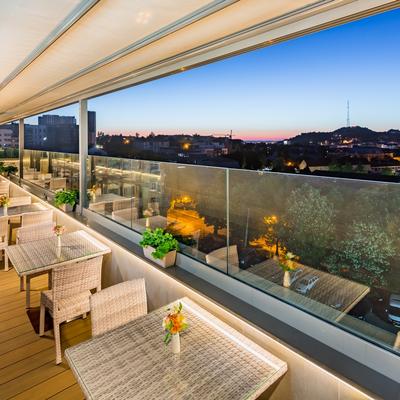
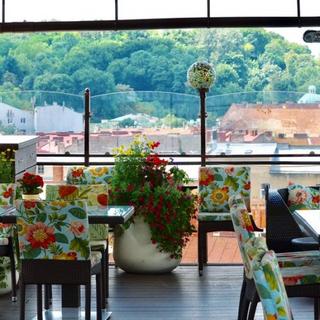
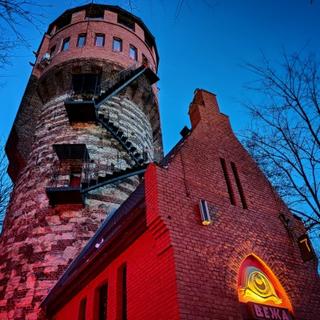
Places with a view — rooftop restaurants offer something that needs neither music nor a programme: Bar Panorama at the Dnister Premier Hotel and the Vezha panorama bar. One thing worth checking here: whether the terrace will be open in December.
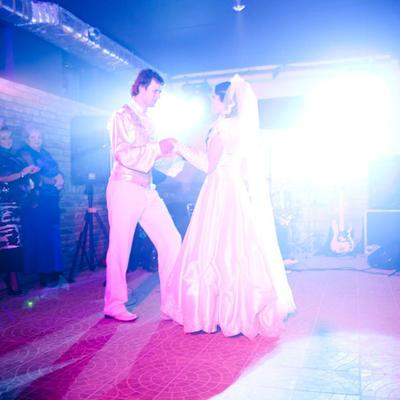
Places built around music — venues with live music, such as Soprano. Here the music isn't background but the programme itself, so questions about set times and breaks become the main ones.
Somewhere near water — waterside venues work through a completely different channel: the view and the pace, not the sound.
And for a large group that needs to set its own volume rules, there are private halls — Valentino or Fazenda na Goncharah: there you control the music and lighting yourself, which, judging by all the figures above, is the most reliable option for a long evening.
The bottom line: music won't save an evening, and it won't ruin one either. But six hours in a loud hall will — no matter what's served at the table.