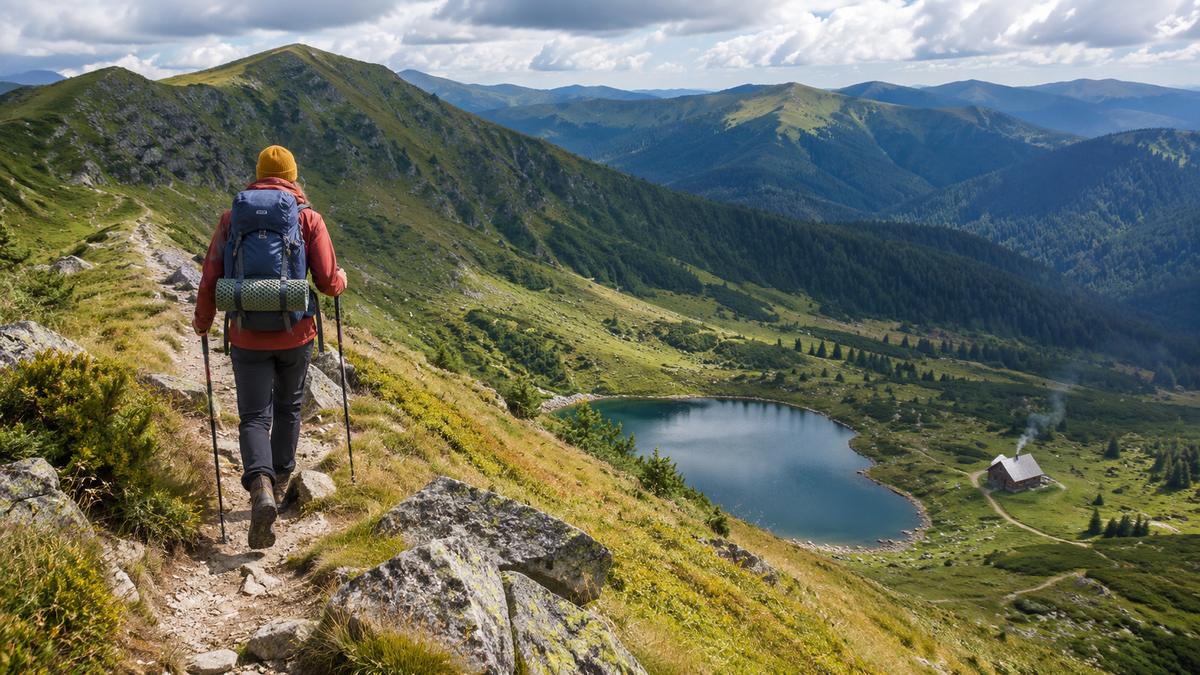
The most common mistake on a short mountain trip isn't bad weather or a long drive. It's arithmetic: the plan includes a route that simply doesn't fit into the time available, and the rest of the weekend becomes a rush. The arithmetic that fixes this has existed since 1892.
A rule that's 130 years old
The Scottish mountaineer William Naismith came up with a simple way of estimating walking time in the mountains:
one hour for every 5 kilometres of distance, plus one hour for every 600 metres of ascent.
For example, take a 12-kilometre route with 700 metres of climbing. That works out at roughly 2.4 hours for the distance plus 1.2 hours for the ascent — about 3.5 hours of walking. And that's without breaks, photos, lunch or the journey back.
The rule assumes a reasonably fit walker, ordinary terrain and normal conditions. It was refined later: in 1965 Philip Tranter added an adjustment for fitness, measured by how long it takes you to climb 300 metres over a distance of 800 metres.
The adjustment that explains why plans fall apart
Here is the most useful refinement, and it runs counter to intuition. Going downhill doesn't always save time:
- a gentle descent (a gradient of roughly 5–12°) — subtract 30 minutes for every kilometre;
- a steep descent (more than 12°) — add 30 minutes for every kilometre.
In other words, a steep descent takes you longer than walking on the flat. That's exactly why "up and back down the same path" routes so often end with people returning in the dark: they budgeted for the climb, but not for the way down.
In practice: if the path down is steep, add the full descent time again to your estimate, not half of it.
Temperature: minus six and a half degrees per kilometre
The second figure that decides whether your weekend is enjoyable. In the troposphere, the temperature drops by about 6.5 °C for every kilometre of altitude.
What that means: if it's +10 °C at a base at 600 metres, it will be around +3.5 °C on a ridge at 1,600 metres — before you take the wind into account, and in the mountains the wind is always stronger.
So pack not for the forecast for the nearest town, but for that forecast minus five to seven degrees. A hat in your rucksack at any time of year isn't overcaution; it's the same calculation.
What you don't need to worry about in the Carpathians
This is worth saying too, because altitude sickness often gets brought up where it simply doesn't apply.
Full acclimatisation to altitude does take 7–10 days, and the first adaptations appear within 72 hours. But the research behind those figures is carried out at high altitudes. The highest point in the Carpathians is 2,061 metres, and most holiday bases sit at 600–900 metres.
For two days in the Carpathians, acclimatisation is not an issue. What actually tires you out on a weekend like this is the drive, the climbing and lack of sleep — not thin air.
The real benefit of a mountain weekend — and it doesn't require a summit
There is a well-researched practice with a Japanese name, shinrin-yoku, or "forest bathing". The idea is that you walk slowly, sit or lie in a forest and simply take it in: the sounds, the smells, the light. No route and no goal.
Studies of the practice have found lower anxiety, less tension, fatigue, low mood and irritability, as well as a lift in mood. In one comparison, a walk in the forest had the same effect as an established psychological technique for building empathy.
For planning a weekend, this points to something simple that few people take advantage of: half of what the mountains offer is available without climbing anything. An hour of slow walking in the woods near your base can give you more than a race to the summit with one eye on your watch.
How to plan two days you won't regret
Day one — the journey and the forest. Arrive and don't plan a hike for the same day. A short walk nearby, dinner, an early night. Day two — one route, calculated with Naismith's rule, with double time for any steep descent and a two-hour margin before dark. In between — water and warmth. A pool or sauna after a day at altitude does you more good than a second hike.
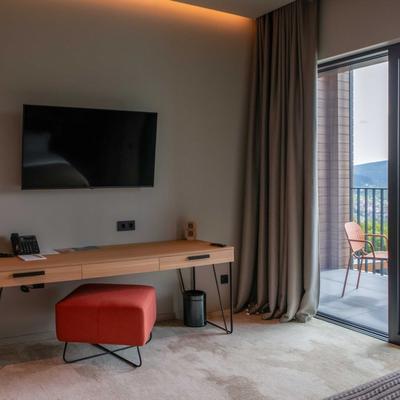
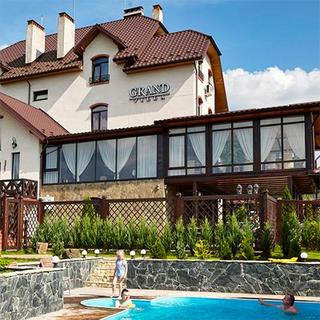
Where to stay: holiday complexes in the Carpathians, and specifically places with a pool. Among them are Panorama Skhidnytsa SPA Resort and Grand Villa.
If you're heading to Slavske, a ski and hiking resort in the Lviv region, you'll find both places to eat and accommodation there: Pearl of the Carpathians Hotel, the 4 Seasons Resort Complex and the Carpathian Fairytale private estate.
In short
Work out your route with Naismith's rule, double the time for a steep descent, subtract 6.5 degrees per kilometre of altitude from the forecast — and leave half of the second day for the forest, with no route at all. That's the kind of plan that leaves you feeling rested on Monday rather than as if you've just worked a shift.