"A romantic evening" is a phrase that describes the setting: candles, a view, soft music. Relationship research has measured something else — which parts of an evening actually affect how a couple feels afterwards. And it turns out the setting isn't at the top of that list.
Seven minutes of something new
A classic series of experiments (Aron and colleagues, 2000) tested a simple hypothesis: taking part together in a new and mildly exciting activity improves how people rate their relationship.
Three laboratory experiments were enough: after a seven-minute novel task, couples rated their relationship more highly than after a mundane one. A control group with no activity at all confirmed that novelty was what made the difference. In the same study, novelty worked by reducing boredom in the relationship — the least romantic mechanism imaginable.
Later work refined the mechanism and made it more interesting. Doing something new together produces two feelings: growth (it's interesting, it's fun) and security (this person can be relied on). When researchers tested which mattered more, the second proved stronger.
This leads to a conclusion that turns the usual logic on its head: an evening for two works not because it's pleasant, but because you do something new together — and so feel like a team. Seven minutes of something new count for more than three hours of the familiar.
You don't both have to find it equally exciting
A separate study — four diary series, 512 couples, 21 days of observation — looked at whether partners need to experience the same level of novelty for it to have an effect.
The answer: they don't. Matching levels added nothing. Satisfaction was higher among those who personally experienced more novelty, and one's own experience consistently mattered more than the partner's.
In practice, this removes the most common obstacle: there's no need to look for an activity that will thrill you both equally. It's enough for each of you to find something of your own in the evening — as long as it happens together.
Seventy-eight decibels
The second number — and it will save more evenings than any advice about candles.
Researchers recorded the conversations of twenty-two couples at different levels of background noise. People adapt sensibly: they move closer together, speak louder, adjust their rhythm. But at around 78 decibels these strategies stop coping, and misunderstandings start to multiply quickly.
78 decibels isn't a rock concert. It's an ordinary full room with live music.
So the first choice to make about the evening isn't the cuisine or the view, but whether you've come to talk. If you have, the question to ask the venue is a prosaic one: will there be live music tonight, and how loud? If not, then the music is the point of the evening — and that's a perfectly good plan too, just a different one.
For the first case, choose restaurants with separate dining rooms and rooftop venues, where sound is less enclosed. For the second, there are venues with live music, where the volume is part of the idea.
What to talk about — and what turned out to be a myth
This is a good example of science correcting itself.
In 2010, a study of 79 students (recording short snippets of their conversations over several days) concluded that happier people have more meaningful conversations and less small talk. The second half of that conclusion was widely quoted.
In 2018, the same study was repeated with 486 people from very different groups. The first part held up: the quality of conversations is indeed linked to higher wellbeing. The second part did not: small talk turned out to be neither harmful nor beneficial. There's simply no link.
The definition the authors gave is useful in itself: small talk is a conversation after which both people know exactly as much about each other as they did before. A meaningful one is a conversation in which some new information has actually emerged.
So there's no need to "fill" the evening with deep topics. It's enough to have the chance for at least one such conversation — and for that you need not inspiration but the same thing as in the previous section: being able to hear each other.
Three formats that cover both numbers
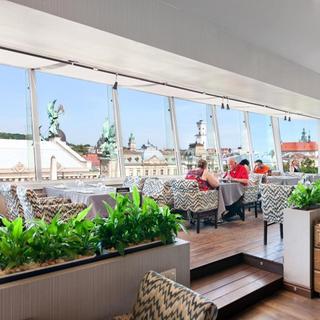
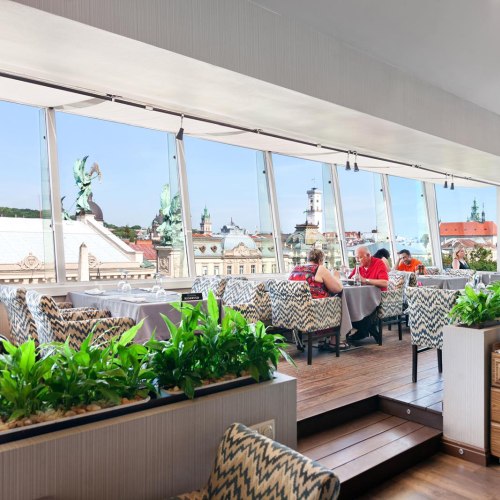
A new place where you can talk. A venue you haven't been to before is the cheapest novelty of all: Panorama Restaurant overlooking the Lviv Opera House, the Vezha Panorama Bar, or the honey-themed restaurant Beehive with its rather unusual concept.
A trip out with plenty to look at. The banquet space at Svirzh Castle or Knyazhyy Dvir Restaurant — here the novelty lies not in the menu but in the journey and the place.
A shared activity, not just dinner. Anything from the activities section where you're both beginners. Seven minutes — and then dinner.
There's one practical takeaway for Lviv. The catalogue has at least fifty venues with a 3D tour, and every one checked has its own profile — so you can look at the room, the seating and the distance between tables before booking. For an evening for two, this matters more than the menu: you can see whether there's a corner table and whether the neighbours will be sitting a metre away.
Why 31 December is the worst evening of the year for dinner for two
Everything described above works against you on New Year's Eve. Venues switch to fixed-price set menus, rooms are full of large groups, the music is louder than usual, and the entertainment is designed for groups rather than couples. The quiet conversation that makes an evening for two what it is becomes technically impossible.
The practical solution is simple: spend 31 December however you like — with friends or at home — and move your evening for two to 2–5 January. That way you get the same place without the mark-up, at a normal volume, with the regular menu and a waiter who has time for you. And it's the one week of the year when tables you'd have to fight for in December are free.
In short
Two numbers replace all the advice: something new together and under 78 decibels. Candles, a view and the right music are pleasant, but they aren't on the list of things that make a measurable difference.