The problem with a day out with children is rarely a lack of places to go. It's about order and balance: how much physical activity, when to eat, what to do about screens, and where the point lies after which everyone has had enough. Three numbers set that order.
Number one: sixty minutes of activity is the minimum, not a bonus
The recommendation for children and teenagers aged 5 to 17 is at least 60 minutes of moderate-to-vigorous physical activity a day. Not a nice-to-have, but the baseline.
What this means for a day out: if the day consists of a museum, a café and a film, the target won't be met, and the evening meltdown will come not from too many impressions but from sitting still too long. Put activity first on the list, while everyone still has energy, rather than last, "if there's time".
The easiest way to get it is somewhere children move of their own accord, without anyone organising them: the Bohdan Khmelnytsky Park of Culture and Leisure or any other park. Water counts too: Pljazh Water Park, the Dolphin Water Recreation Center and the Medic Sports and Entertainment Complex give an hour of activity that doesn't feel like a chore. For the full list, see places with a pool in the relaxation section.
Number two: thirteen years for VR
This is where parents most often miss the key point. Most VR headsets are not intended by their manufacturers for children under 13 — and that's not a formality.
The reasons are stated plainly: a child's eyesight is still developing, virtual reality makes even some adults feel sick, and there is still a lack of long-term research on its effects on children. Some industry guidelines set the limit at "over 12"; since the end of 2023, major manufacturers have allowed children aged 10–12 to use headsets only through parent-managed accounts.
If VR is on the plan anyway, three rules apply:
- The 20-20-20 rule: every 20 minutes, spend 20 seconds looking at something far away, about six metres off. It applies to any screen, not just a headset.
- Clear space of at least two by two metres, with no furniture, away from doors and stairs.
- Five to ten minutes to get oriented in the room before the game starts — the child needs to understand where they're standing while the headset is still off.
A calmer alternative with the same "wow" factor: the Dovzhenko Cinema Palace or museums, where there's plenty to take in and no headset.
Number three: three per cent
A study of children's meal deals at twenty-six large restaurant chains produced a finding worth knowing: only 3 % of the meals met the guidelines on every measure at once.
The figures for a standard meal: about 584 kilocalories and 35 grams of sugar. The same meal in its "lightest" version came to 400 kilocalories and 14 grams of sugar, and in its "heaviest" to 792 and 51.
And the most important finding of that study: the drink makes the biggest difference. That one choice cuts about a hundred kilocalories and twenty grams of sugar — more than any other change to the meal. The second most effective swap is the side dish.
So the conversation with your child about the menu comes down not to "don't eat that" but to a single question: what are we drinking? Everything else can stay as it is.
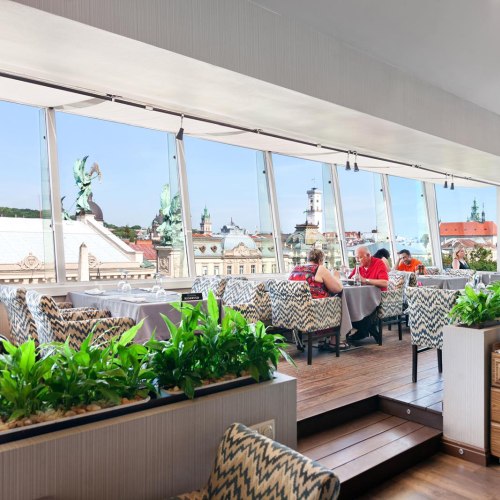
Children usually respond better to places where the venue itself is an attraction, not just the food: the restaurant-museum Sim Porosiat ("Seven Piglets") is one of these.
How it fits into a day
The order that follows from the three numbers:
Morning — get moving. A park, a pool, a playground. An hour or an hour and a half, while everyone is fresh. Lunch — with a different drink. And unhurried: adults need the break just as much as children do. After lunch — one experience. A museum, a film, a workshop. Just one: interest in an exhibition lasts about half an hour, and the third item of the day will be the least memorable, even if it might be the most interesting. The end — something calm. Not a new place, but something predictable.
For the full list of places with activities, see the leisure and recreation section; it brings together water parks, parks and venues with programmes.
The one mistake that ruins the most days
Trying to fit everything in. A day with four items is almost always worse than a day with two — not because children "can't cope", but because everyone's attention is limited, adults included.
If you're choosing between "one more museum" and "another hour in the park", the second almost always wins, and not only because of the activity target.
And one more thing that saves arguments on the spot: tell your child the plan in advance, including what won't be in it. "Today it's the park and the cinema; the rides are for next time" works incomparably better than the same refusal delivered on the spot in front of a shop window. Looking forward to something is a pleasure in itself, and it comes free to whoever mentions the plan the day before.