Ask someone to name American food and you'll hear burger, Caesar salad, fries, ribs, cheesecake. Let's check these dishes' papers. Some turn out to carry a foreign passport, but along the way it becomes clear what this cuisine is really made of.
Caesar: a party in another country
This salad has nothing to do with the Roman emperor and, strictly speaking, wasn't born in the USA. The Italian immigrant Caesar Cardini ran a restaurant in Tijuana, Mexico, where Californians went for everything Prohibition had banned at home.
According to his daughter Rosa, so many guests turned up on 4 July 1924 that supplies nearly ran out. Cardini gathered what he had to hand and tossed the salad in the middle of the dining room, so that people got a show as well. In a 1987 interview, Rosa recalled that her father used only the tender inner leaves of romaine and didn't cut them, since the leaves were meant to be picked up with the fingers. He boiled the eggs for exactly one minute and left out the anchovies.
This whole picture rests mainly on a family story. In another version, his brother Alex made a similar "aviators' salad" with lime and anchovy paste, while some credit the recipe to the mother of the chef Livio Santini. Nobody knows for certain who invented it. It was Cardini, however, who registered the trademarks in his own name in 1948.
The potato with the unfortunate name
Fries come with a burger so automatically that they seem American. Their origins are uncertain, as Britannica readily admits: one tradition says France, a newer version says Belgium.
Belgians and French are still arguing. Pierre Leclercq, a food historian from Liège, maintains that fries were invented by street vendors in Paris. There's also the Bavarian musician Frédéric Krieger, who supposedly learned to fry them on the rue Montmartre in 1842 and in 1844 was selling "fried potatoes as in Paris" in Belgium. Popular history credits the word "french" to American soldiers in Belgium during the First World War, but Leclercq finds the phrase "french fried potatoes" as early as 1857.
Barbecue: smoke, spices and other people's labour
Here is a truly American story, though not a simple one. American barbecue has been called a collision of three worlds. Indigenous peoples roasted and preserved bison and venison over fire. The word probably comes from the Taíno people of the Caribbean, whose wooden smoking racks the Spanish wrote down as "barbacoa". Europeans added pigs, cattle and the habit of basting meat with butter or vinegar.
The flavour we recognise today was largely shaped by people brought from Africa as slaves. They worked the fires on plantations, seasoned the meat with spices and chilli, and tended heat and smoke round the clock, while plantation owners hosted the great barbecues. When you order BBQ ribs, this part of the history comes with them, and you won't find it on the sauce bottle.
A cookie with an advertising legend
Ruth Wakefield studied home economics and ran the Toll House inn in Whitman, Massachusetts, with her husband. The building was never a toll house, despite the name. To vary the butter cookies she served with ice cream, she chopped up a bar of Nestlé chocolate with an ice pick and folded it into the dough. The recipe appeared in her 1938 cookbook as the "Toll House Chocolate Crunch Cookie".
The popular version says the chocolate was meant to melt and the result was an accident. Nestlé's advertising spread that story, whereas Wakefield herself said she did it on purpose, wanting to give her guests something new. Until 1940, chocolate chips weren't widely sold: in fact, they began to be made because of this cookie.
The cheese that wanted to be French
New York cheesecake relies on cream cheese, which also came about because of someone else's product. In 1872, the dairyman William Lawrence of Chester, New York, tried to reproduce French Neufchâtel and got something thicker and creamier. By the end of the 1920s, cream cheese had reached the Jewish restaurants of New York. The restaurateur Arnold Reuben claimed to have been the first to make cheesecake with it, but that's his own say-so.
Every dish on this menu has survived something: immigration, Prohibition, slavery, advertising.
What else is on the menu
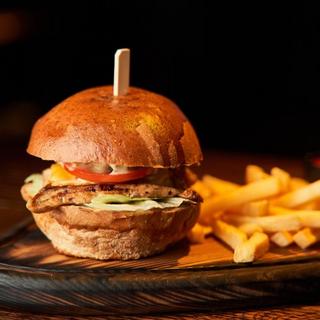
Burger. A beef patty in a soft bun; a cheeseburger adds melted cheese.
Hot dog. A sausage in a long bun with mustard.
Buffalo wings. Fried chicken wings in hot sauce.
Brownie. A dense chocolate square with a moist centre.
Eggs, bacon and pancakes. The American breakfast at its simplest.
Old Fashioned. A cocktail of bourbon, sugar and bitters, slow and free of frills.
Where to try it in Lviv
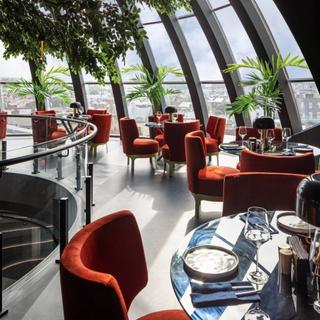
Places are gathered in our selection of American restaurants. For the taste of smoke, head out to Briukhovychi, where Eco AQUARIUS Grill Restaurant cooks pork ribs in a smoker. The Good Friend Pub has both a cheeseburger and a Caesar on its menu, so you can check the papers of both in one evening. And CLOUD no.7 Panorama offers New York cheesecake and a brownie with bergamot.
Behind many American dishes stand people whose names no menu will ever mention.
Menus change, so a dish mentioned here may no longer be available. If it's the reason you're going, it's best to call ahead.