French menus can put people off by their sheer length: starters, fish, meat, cheese, dessert, plus a glass at the beginning and another at the end. It all seems designed for grand evenings and people with good posture. In fact, the sequence is described quite precisely, and French dining out began with soup for the weary.
An establishment named after broth
Until the second half of the 18th century, eating out in Paris was a dull affair. Inns fed people and horses in much the same way, taverns lived off drink, and rôtisseries sold roast meat to take away. There was nowhere to choose a dish from a list and eat it in peace.
In 1765, Mathurin Roze de Chantoiseau began serving small cups of broth at marble tables on the rue des Poulies, near the Louvre. A Latin phrase hung above the door: let all whose stomachs ache come to me, and I will restore them. At the time, "restaurant" meant the dish itself, a strong broth that brought back your strength. Only gradually did the word come to mean a place, and the Académie française confirmed the new sense as late as 1835.
Here our knowledge runs out: alongside Chantoiseau, old texts mention a certain Monsieur Boulanger. It's hard to say today which of them was first in the full sense.
Two glasses and four courses in between
In 2010, UNESCO added the gastronomic meal of the French to its list of intangible heritage. One detail matters: by "gastronomic" the listing meant not haute cuisine, or even simply good food, but the rules by which people sit down to eat for a birth, a wedding or a reunion.
The pattern is spelled out. First an aperitif, liqueurs at the end, and between them at least four courses: a starter, fish or meat with vegetables, cheese and dessert. The French also smell and taste their food right at the table, and that made it into the description too. It's the handiest key for reading a menu.
What's on each page
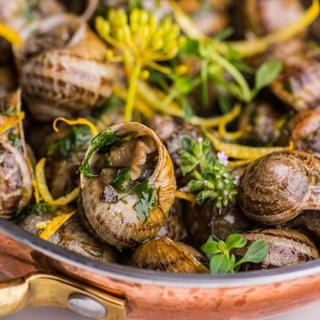
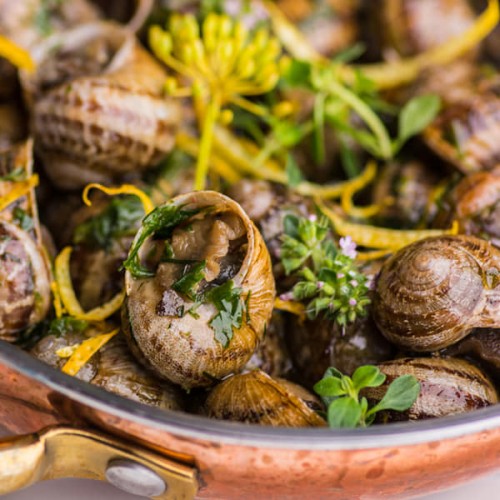
Starters. Onion soup made from long-caramelised onions and baked with a crouton and cheese. Snails (escargots) with garlic butter. Foie gras, the fattened liver of duck or goose. Quiche lorraine, an open tart with a filling of eggs and cream.
Fish and meat. Bouillabaisse from Marseille. Boeuf bourguignon, beef braised in red wine. Coq au vin, rooster cooked in wine. Duck confit, a leg cooked slowly in its own fat. Chateaubriand, a thick cut from the centre of the beef fillet. Ratatouille, a vegetable stew from Provence, alongside or on its own.
Cheese. A course in its own right rather than a nibble with wine: in the French order it follows the meat.
Dessert. Crème brûlée, tarte Tatin (an upside-down apple tart), eclairs and profiteroles made with choux pastry.
The glass. Champagne at the start, cognac at the end.
The soup that needed protecting
Bouillabaisse began as the food of Marseille fishermen, who cooked whatever they couldn't sell. According to a common explanation, the name comes from Provençal: as soon as it boils, turn down the heat. Where the recipe came from is still argued over, even in Marseille.
The trouble began when tourists fell in love with it. Some restaurants started calling any fish soup bouillabaisse, so in 1980 a group of restaurateurs drew up a charter. There must be at least four kinds of fish from a set list, and the dish is served in two stages: first the broth with croutons and rouille sauce, then the fish with potatoes.
The charter isn't law, and some people in Marseille follow its rules without having signed it. Beyond the Mediterranean, bouillabaisse can only ever be a copy, because the charter calls for local rockfish. Away from Marseille, then, it's always a free interpretation, best judged on taste.
The queen who taught nobody
Almost every popular history of French cooking repeats the same tale: in 1533 Catherine de' Medici arrived in France with Italian cooks, and only then did the French learn to eat. The food historians Barbara Ketcham Wheaton and Stephen Mennell have demolished this version. The French nobility had encountered Italian cooking much earlier, during the Italian Wars, and while Henry II was alive, Catherine had almost no influence at court.
Most curious of all, the legend arose two centuries later. According to one version, it began as a reproach: the article "Cuisine" in Diderot and d'Alembert's Encyclopédie of 1754 blamed overly elaborate sauces on the "corrupted Italians" at Catherine's court. An insult became a compliment that's still being repeated.
A croissant from Vienna, a custard with three homelands
The symbol of the French breakfast also came from elsewhere. The croissant grew out of the Kipferl, a crescent-shaped Austrian pastry. In the late 1830s, the Austrian officer August Zang opened a Viennese bakery on the rue de Richelieu in Paris, and local bakers took up the idea. The pretty stories about a victory over the Ottomans in 1683, or about Marie Antoinette bringing the recipe with her, have no convincing evidence behind them.
Crème brûlée is more tangled still. The earliest known recipe for a dessert of that name was printed in a 1691 book by François Massialot: the sugar on top of the custard had to be scorched with a red-hot shovel. Catalonia, with its crema catalana, and England, where the dish was known as "burnt cream", lay equal claim to it. The spoon you crack the caramel with stays neutral in this dispute.
Where to try it in Lviv
There's a list in our selection of French restaurants. To find out whether this is your kind of food at all, go to Tante Sophie: snails come in and out of their shells, by the dozen and half-dozen, and you can finish with crème brûlée. At Szkocka, look for bouillabaisse and pot-au-feu, the French beef soup. And traditional onion soup is on offer at the Black Cat pub and restaurant.
French cuisine began with a promise to restore your strength, and it's still food for people in no hurry.
Menus change, so a dish mentioned here may no longer be available. If it's the reason you're going, it's best to call ahead.