You may feel you know everything about this cuisine because you grew up on it. But how many kinds of borscht have you really tried: the same one with sour cream, or genuinely different ones? Many of us know a simplified version, and the reasons for that are specific and well documented.
A Lviv merchant and the Borshchivka river
On 17 October 1584, a merchant caravan from Lviv stopped for the night near Kyiv by a river that the trader Martin Gruneweg recorded in his diary as the Borshchivka. The people of Kyiv told him the name came from a local borscht market. Gruneweg had his doubts: why travel so far from the city centre for borscht? Historians regard this entry as probably the first documented mention of Ukrainian borscht.
So people have been arguing about borscht for more than 440 years.
The first case heard out of turn
On 1 July 2022, UNESCO added the culture of cooking Ukrainian borscht to its list of heritage in need of urgent safeguarding. For the first time in history, the nomination file was considered ahead of schedule, because of the war and the threat to the bearers of the tradition themselves.
The wording deserves a close look. What came under protection was the culture of cooking: the different recipes, the method, and the occasion for making one borscht or another. Braichenko, the author of a book on the history of Ukrainian food, points out that borscht can be green or red, and that in Soviet times it was reduced to a handful of standard ingredients. It remains to taste the difference. Poltava borscht, made with chicken, comes with halushky dumplings; the Galician (western Ukrainian) and Lviv versions have recipes of their own; green borscht is made with sorrel in spring, and cold borscht in summer.
Varenyky never went anywhere
Many articles on this cuisine claim that varenyky (filled dumplings) derive from the Turkish "düş-vara". The researcher Vsevolod Polishchuk checked this version, along with the Chinese and Polish ones. His conclusion is inconvenient for lovers of a good legend: Turkish sources don't present the dish as their own, and the theory of Chinese origin via the Mongols has no archaeological or documentary support. The name makes perfect sense without Turkey, too, since Ukrainian has the verb "varyty", to boil.
We still don't know exactly where the idea of boiled dough with a filling came from. There's no convincing evidence of borrowing so far, and that alone is reason to be more careful about repeating the pretty legend.
Potatoes are the new arrivals
Much of what feels age-old today is younger than the Cossack era. Potatoes appeared on Ukrainian lands in the second half of the 18th century and spread widely only in the 19th. So deruny (potato pancakes) and potato varenyky can't be ancient. Before potatoes, soups were made with parsnips and turnips, and in Volyn they became an obligatory part of borscht only in the second half of the 19th century.
The same goes for the festive table. According to ethnographers, kutia (sweet wheat-berry porridge) and uzvar were required at Christmas almost everywhere in Ukraine except Transcarpathia. The famous twelve dishes, however, appear in old descriptions far less confidently than we're told.
A cuisine rewritten
In the second half of the 20th century, Soviet specialists effectively created a new canon of national dishes. Researchers whose work is gathered in a digital library of culinary texts from the Ukrainian lands show that this codification came after the Holodomor, which wiped out entire communities along with their culinary knowledge. Culinary councils decided which recipes to promote and which to strike out. Convenience foods and a network of canteens did the rest, and regional differences all but vanished.
What stayed outside the canon survived in books and notebooks. As early as 1913, Zinoviia Klynovetska published Stravy y napytky na Ukraini ("Food and Drink in Ukraine"), with more than a thousand recipes from different regions, both peasant and noble. And Dariia Tsvek, a native of the Ternopil region, was writing down family recipes while still a schoolgirl; her books preserved the western Ukrainian way of cooking.
Today, modern authors carry this work on. Lviv journalist and restaurant marketer Vsevolod Polishchuk, a co-founder of the Galician Cuisine Club, published The Fantastic History of Ukrainian Cuisine with Vikhola in 2025. He debunks myths about the most popular dishes and traces where they really come from, right down to the question of who actually invented borscht. The book also has recipes for dishes that were once everyday food, such as the layered cabbage dish Ivan Franko loved, or borscht with strawberries.
What to order
Borscht. Red, green or cold, and then by region. Served with sour cream and pampushky, garlicky bread rolls.
Varenyky. Filled with potato, curd cheese, cabbage or sour cherries. Crispy pork crackling and fried onions go with the savoury ones.
Holubtsi. Stuffed cabbage leaves, in old Volyn recipes filled with millet or buckwheat and grated potato.
Deruny. Grated potato pancakes, called terti plyatsky in Galicia.
Krucheniki. Stuffed meat rolls, usually with a mushroom filling.
Salo. Cured pork fat, salted, boiled or smoked, and also used to lard meat.
Chicken Kyiv. Its origins are tangled, with the French de volaille somewhere in the mix, and the question is still debated.
Uzvar. A drink of stewed dried fruit.
Syrnyky. Fried curd cheese patties. The Lviv syrnyk merely shares the name: it's a baked dish, and you should ask for it separately.
Where to try it in Lviv
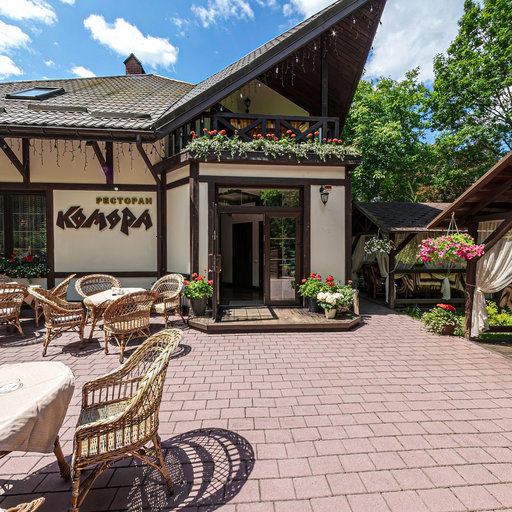
There's a list of places in our selection of Ukrainian restaurants. To compare versions of a single dish, visit Komora, where varenyky come with duck and crackling, deruny with porcini, and the soups include sorrel borscht. The Zustrich Cafe Bar keeps mushroom krucheniki and uzvar on the menu. And at Hutsuls'ka Grazhda, look for the "Lviv" borscht with homemade sour cream.
The most interesting thing about this cuisine is that it can still be rediscovered, and two bowls of borscht in a row is a fine way to start.
Menus change, so a dish mentioned here may no longer be available. If it's the reason you're going, it's best to call ahead.