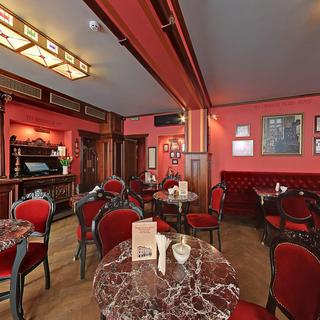
Ask what's local in Lviv and the answer may well begin with an Austrian cake. Galician (western Ukrainian) cooking is best described by the menu of a single dinner rather than by any one recipe, so let's start there.
A dinner that could only be served here
One account of Lviv's food paints this picture: over a single dinner, one family might serve Polish bigos, Ukrainian varenyky (filled dumplings), Jewish forshmak, and then Hungarian or Austrian sweets, or even Tatar nougat, for dessert. That list is the definition.
People often try to claim this cuisine for one culture or another. Food researcher Marianna Dushar answered them directly in a piece for Radio Svoboda: "Galician cuisine is composite by its very nature." It can't be called purely Ukrainian, Polish or Jewish. The same piece offers a telling example: the Lemkos have zhur, Lviv has it too, and in Poland it's zhurek. Who took it from whom is a nearly hopeless question.
The traces reach beyond Galicia. In Poland's Lower Silesian Voivodeship you can still find recipes for "Galician-style parsnip soup" and "Lviv-style" parsnip dumplings.
Why Lviv?
The city had two specific reasons. The first was trade. As far back as the Middle Ages, Lviv's fairs sold imported lemons, olive oil, Gdańsk herring and wine alongside local goods.
The second was bureaucrats. Under "Grandma Austria", as locals call the Habsburg era, officials arrived from Vienna in large numbers, bringing their cooks and their wives with the latest recipes. Strudels, Pischingers and Sachers are said to have appeared in Lviv almost as early as in Vienna.
According to the Viennese company's own history, Oskar Pischinger's wafer cake dates from the 1880s, and its recipes soon spread through Galician cookbooks.
What's on the menu
Zhurek. A sour soup made with a fermented starter, often with smoked meats.
Bigos. Stewed cabbage with meat.
Flyachky. A thick beef tripe soup, and not for everyone.
Forshmak. A herring-based pâté.
Terti plyatsky. Grated potato pancakes, known as deruny further east.
Knedli. Boiled balls of potato or wheat dough.
Strudel. Most often apple, in thin pastry.
Sacher. A chocolate cake of Viennese origin.
Pischinger. Wafer layers with chocolate cream.
Lviv syrnyk. A baked Ukrainian cheesecake, with or without a base and usually under a chocolate glaze. One recipe has the finished cake cooling for 2–3 hours and then spending as long again in the fridge, so there's no use rushing it. Wikipedia notes that a so-called Viennese cheesecake became popular in urban cooking. Whether it's the direct ancestor of the Lviv version could not be established.
Recipes preserved on paper
Galician cuisine has a library of its own. Home Cooking by Leontyna Luchakivska, a priest's daughter from the Ternopil region, came out in 1912. Practical Cooking by Olha Franko, daughter-in-law of the writer Ivan Franko, served many housewives as a textbook. Recipes also ran in the Lviv magazine Nova Khata, published from 1925 to 1939.
The same Radio Svoboda piece says that Yavoriv pie spread through resettlement or as cultural exchange, while Lviv itself was known for an onion pie with bryndza or cheese. Try asking about it at a modern restaurant.
Less coffee than the stories suggest
Now for the city's loveliest legend. In 1683, Yurii Kulchytskyi supposedly seized three hundred sacks of coffee from the Turks and taught Vienna to drink it with milk. The Blue Bottle coffee house did become part of Vienna's history, but it wasn't Europe's first: coffee houses were already open in Paris, Amsterdam and London, and more recent sources credit Vienna's own first one to an Armenian, Johannes Diodato. There are no documents about the "three hundred sacks", and according to Professor Michael Moser of the University of Vienna, the stories about Kulchytskyi are attested only from the late 18th century.
In Lviv the evidence is thinner still. The first coffee house turns up in the sources quite late. The earliest documented one is Jakub Lewakowski's establishment, described by Joseph Rohrer: his book came out in 1804, and the mention is dated to 1802. The year 1801 also appears. The researcher Polishchuk considers the tale of Kulchytskyi's descendants opening coffee houses in Lviv a myth. The local historian Ilko Lemko makes things more awkward still: "coffee is a legend of the Soviet era", and before that Lviv was neither a coffee city nor a beer city.
The coffee in Lviv is real. Its legend is just much younger than its aroma.
A stronger drink with its own history
Another drink has far deeper roots. In 1782, the entrepreneur Leiba Bacheles founded a distillery in Vybranivka near Lviv, and in 1810 his descendant Leopold Baczewski moved production to Znesinnia. The factory's products won awards in Vienna, Amsterdam, London and Paris. The sources get somewhat muddled over the family tree: some call Leopold the founder's grandson, others his son. The factory operated until 1939, and there are now plans to restore its former bottle warehouse on Bohdana Khmelnytskoho Street as a retail and exhibition space.
Where to try it in Lviv
You'll find a list of places in our selection of Galician restaurants. Bachevski Restaurant serves Lviv-style zhurek in a bread bowl and Lviv syrnyk in a section of the menu called "Leguminy". Amadeus has homemade baked flyachky and Viennese potato knedli. And at the Ionov family's pastry shop Under the Golden Star, you can put Lviv syrnyk and Sacher side by side and decide for yourself which is related to which.
The most Galician thing about this cuisine is that it never asked a dish for its passport.
Menus change, so a dish mentioned here may no longer be available. If it's the reason you're going, it's best to call ahead.