Most cuisines can be pointed to on a map. This one can't. It was cooked in Galicia (western Ukraine) and the Middle East, in Morocco and Poland, and the recipes have almost nothing in common. Researchers say as much: there is no single Jewish cuisine. There are shared rules by which different people in different lands decided what to put on the plate.
Rules instead of geography
Kashrut, the Jewish dietary law, sets the framework. Meat and dairy aren't mixed, in the dish or in the cookware. Pork is out. So there's no cream sauce with veal and no cheese on a meat patty, which explains a good many unusual combinations straight away.
The calendar is the second framework. The Sabbath and the holidays dictate what can be cooked and when. Very different tables grew from these two supports: Ashkenazi, from cold Central and Eastern Europe, heavier and plainer; Sephardi, Mediterranean; and Mizrahi, Middle Eastern. Israeli cuisine has its own article in this magazine. Here we'll talk about the table that stood next to ours.
A pot in the baker's oven
Lighting a fire is forbidden on the Sabbath. One of this cuisine's most ingenious dishes answers that ban: cholent, a thick stew of beans, barley, potatoes and meat. The pot was assembled on Friday and carried to the baker, whose oven stayed hot. On Saturday morning it was collected and taken home.
Nobody has settled where the word comes from. There's a respectable theory pointing to the Latin calentem, "hot", and a pleasant folk one about the French for "hot and slow". The idea itself is beyond doubt: Morocco did the same, only with a stew of its own.
The line that divided the fish
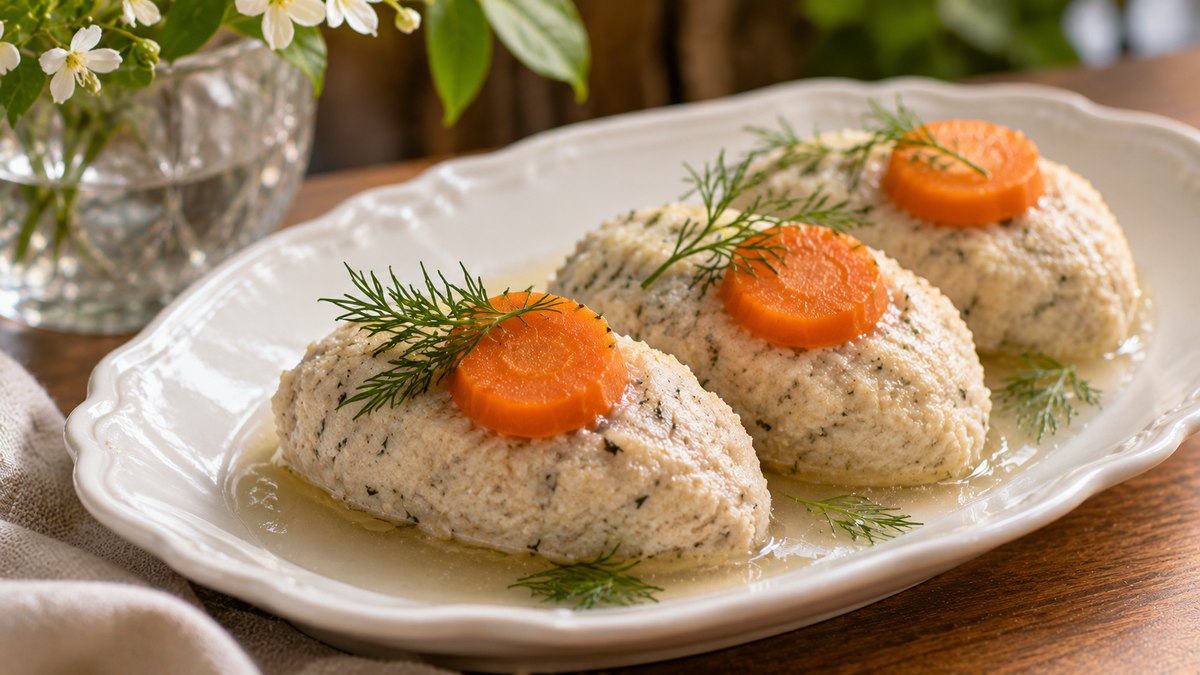
Gefilte fish, stuffed fish that's often carp, is the symbol of the Ashkenazi table. The usual explanation is that bones can't be separated from flesh on the Sabbath, so the fish was ground in advance. Some rabbis disagree, noting that the dish is much younger than the prohibition and that fish was eaten on the Sabbath for a millennium and a half before it.
Something else is far more interesting. In the 1960s the Yiddish scholar Marvin Herzog drew a map of taste: on one side the fish was sweetened, on the other it was peppered. Galician Jews belonged to the sweet side, while the Litvaks, their northern neighbours, preferred pepper. The reason is linked to sugar beet, a new industry that sprang up in these very lands in the early 19th century.
A fish like this tells you nearly as much about a family's origins as its language does.
What was eaten "before"
Forshmak has an intriguing name. It comes from the German Vorschmack, "foretaste", a starter. Ashkenazi Jews turned it into a cold dish of chopped herring, and the difference has survived in the words: "forshmak" took hold in Ukraine, while in Poland and Lithuania people said gehakte hering, simply chopped herring. Old salted herring was soaked in tea to soften it, because that was the fish even the poor could get.
Bread with a hole
The first written mention of the bagel lies close by: the regulations of Kraków's Jewish community from 1610, which allowed this bread to be given to women in childbirth. Legends about its origins are countless, and nearly all of them are later than this document. The best thing about it is how thoroughly mundane the rule is.
Challah is the braided Sabbath loaf, the best known item on this table. Tzimmes is carrot stewed with dried fruit and honey, eaten at the Jewish New Year: the round slices look like coins, so this is a dish about prosperity. In Yiddish the word also means fuss and bother. To "make a tzimmes" of something is to raise a needless commotion.
The rules didn't impoverish this cuisine. Every prohibition demanded an invention, and nearly all its famous dishes grew out of something you weren't allowed to do.
In Lviv
There's a dedicated selection of Jewish restaurants. A dish's name doesn't mean kashrut is observed, so if that matters to you, ask separately. Carp stuffed Jewish-style is sold at the deli counter of Under the Golden Star. Bachevski Restaurant has a starter ironically called "Not Forshmak", with matzo on the side, and Panorama serves cream of forshmak on brioche.
A dish can outlive borders, as long as there's a rule behind it that someone goes on remembering.
Menus change, so a dish mentioned here may no longer be available. If it's the reason you're going, it's best to call ahead.