It's easy to think of Greek food as unchanging: olives, feta, ancient gods, thousands of years of the same lunch. Ask when the dish on your plate actually appeared and things get more interesting. Some of the most Greek things around are younger than your grandmother.
The salad of the cheap lunch
Horiatiki, or "village salad", is tomatoes, cucumber, onion, olives and a slab of feta on top, dressed with oil. A true version has no lettuce, because this is a dish made from the summer harvest.
What we call Greek salad became popular as a restaurant item of its own in the 1960s, along with the tourist boom in Athens. The Greeks even had a joke about it: travellers who ordered the salad and nothing else were known as "horiatiki tourists". A humble plate ended up as the country's calling card.
The chef who wanted to re-educate everyone
Moussaka existed earlier, in versions related to the cooking of the Ottoman Empire. The one you're picturing, with its layer of aubergine, layer of meat and thick cap of béchamel, is largely the work of one man.
Nikolaos Tselementes trained as a cook in Vienna, worked in America and published a cookery manual that became the standby of urban kitchens (a magazine by that name was already appearing around 1910; the complete book is dated to 1932). He wanted to cleanse Greek dishes of their Ottoman traces and bring them closer to French models. That's where the béchamel on moussaka comes from.
Opinions still differ: to some he's a reformer, to others a man too taken with the French example.
The cheese a country went to court over
Feta looked like a name anyone could use, until Greece decided otherwise. It was first registered in 1996, but in 1999 the EU court annulled the registration. A second attempt followed in 2002, opposed by Germany and Denmark, where a white cheese of their own was sold as feta and which argued that the name had become generic, like cheddar.
In October 2005 the court sided with Greece. One argument stood out: Danish law itself said "Danish feta", so the word alone, without a qualifier, seemed to point to Greece even there. The dispute dragged on, and in 2022 the same court rebuked Denmark for selling "feta" outside the EU. Today, feta packaging in Europe carries a protected origin.
A skewer more than three thousand years old
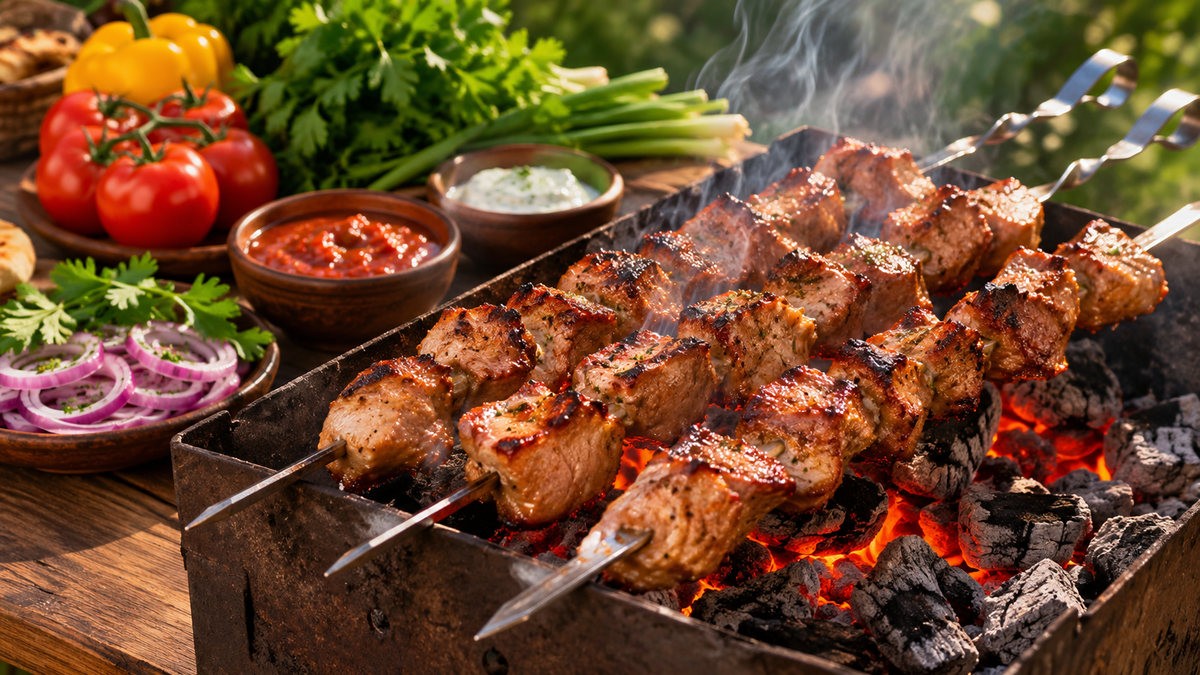
The Greeks called a small spit an obeliskos, and Aristophanes already mentions one. Archaeologists have found still older ceramic skewer trays from the Mycenaean era at Gla and Pylos, and some researchers think of them as portable grills. The name souvlaki, on the other hand, is late, medieval Greek, and borrowed from a Latin word. Souvlaki became an everyday mass food only after the Second World War.
Even serious scholars haven't agreed whether today's souvlaki continues the ancient tradition or came back a second time through Turkish cooking. But grilling here is so old that the argument is worth having.
The taste of pine
Retsina began as the solution to a technical problem. Porous amphorae let in air, so they were sealed with Aleppo pine resin, and the wine picked up its smell. When barrels arrived under the Romans the need disappeared, but people already liked the taste. Today the resin is added deliberately during fermentation and removed afterwards.
The next bone of contention lies right alongside. The word tzatziki comes from the Turkish cacık: the same cucumber and yoghurt, under almost the same name, is eaten across the former Ottoman world.
A short guide to the menu
Moussaka. A bake of aubergine and meat under béchamel.
Gyros. Meat sliced from a vertical spit, served in pitta.
Souvlaki. Small pieces of meat on a skewer.
Tzatziki. Thick yoghurt, cucumber, garlic.
Feta. A white brined cheese of sheep's milk with some goat's milk added.
If you're ordering lightly, have something off the charcoal and a salad: half of this cuisine depends on the quality of the tomatoes and olive oil.
Where to look in Lviv
The catalogue has no separate Greek selection, so your nearest guide is our list of Mediterranean restaurants. Chicken souvlaki is on the menu at Soprano. At the restaurant of the Lviv Hotel, moussaka takes an unexpected turn with pike-perch fillet, salmon and spinach, a long way from Tselementes. And Black Cat serves Greek salad with no embellishment at all.
In Greece, traditions are usually created by the same people who assure you they've always been there.
Menus change, so a dish mentioned here may no longer be available. If it's the reason you're going, it's best to call ahead.