A Finnish sauna is at ninety degrees, and after ten minutes most people are already eyeing the door. A Turkish bath is at forty-five — and people stay for an hour. The obvious explanation: well, of course, forty-five is less than ninety.
But the humidity in a hammam is close to a hundred per cent, and humid air transfers heat to the skin far more readily than dry air. In other words, moist air is hot too, and comparing two thermometer readings proves nothing. The right question is a different one: how much exactly does humidity claw back of what the lower temperature gives away? And there's a numerical answer.
Humidity really does add to the strain — it's been measured
In 2026, at the University of Jyväskylä in Finland, fifty healthy adults each completed four ten-minute sessions in a Finnish sauna at different combinations of temperature and humidity. The main finding: temperature and humidity affect the body independently of each other — humidity isn't a correction to the temperature but a factor in its own right.
Two coefficients from that study are the whole answer:
- every degree of temperature adds about 1.4 beats per minute to the heart rate;
- every percentage point of humidity adds about 0.37 beats.
The mechanism is well known and simple: heat passes from the hot air to the skin, and steam boosts this transfer through condensation — as it settles on the skin, it releases its latent heat. So a ladle of water on the stones really does make a session harder, and that has been measured.
The exchange rate: one degree ≈ four per cent of humidity
Divide one coefficient by the other and you get something you won't find in any brochure: one degree of temperature weighs roughly as much as four per cent of humidity.
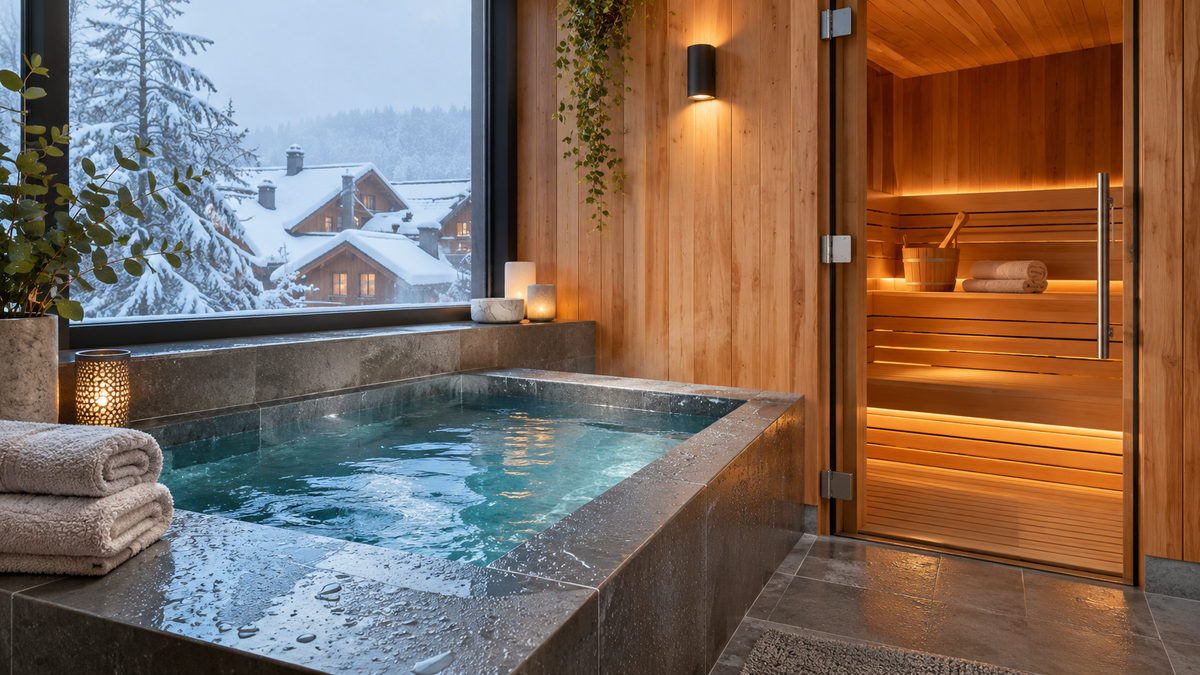
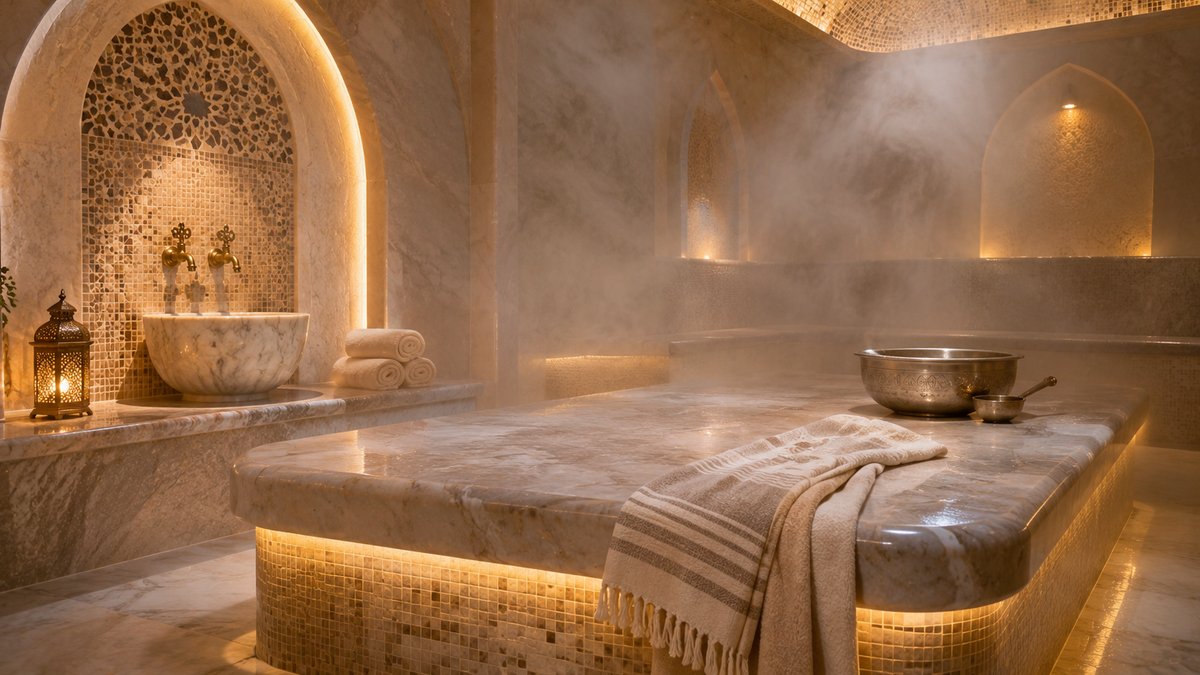
Now plug in real conditions. A Finnish sauna runs at 80–100 °C with 10–20 % humidity. A classic Turkish bath is around 43–46 °C with humidity approaching a hundred per cent.
The hammam gives up forty-five degrees and adds eighty-five per cent of humidity. At the exchange rate, forty-five degrees are equivalent to a hundred and eighty per cent of humidity. Yet the hammam adds only eighty-five. Steam-saturated air doesn't buy back even half of what was given up on the thermometer.
In terms of heart rate, it would look roughly like this: minus sixty-three beats from the lower temperature, plus thirty-one from the humidity. The net result is a difference of thirty-odd beats in the hammam's favour.
An honest limit to this calculation. The coefficients were measured within the range of ordinary Finnish sauna conditions, and 45 °C at a hundred per cent humidity lies far outside it. Stretching the formula that far gives only an order-of-magnitude estimate, not a precise figure. But there's a second argument that needs no formula at all.
The second argument: the gradient, not the degrees
Heat flows into the body faster the greater the temperature difference between the air and the skin. In the heat, human skin stays at around 35 °C. So:
- sauna: 90 − 35 = a 55-degree difference;
- hammam: 45 − 35 = a 10-degree difference.
That's a five-and-a-half-fold difference, and here it's simple arithmetic of the gradient itself. Condensing steam adds its own channel of heat transfer, but it can't make up for a temperature difference that isn't there.
And that's the answer to the question in the headline. Humid air really is hot and really does add to the strain — it's just that a forty-five-degree gap is too large for humidity to cover.
And here the reverse point is worth making, because without it the picture is incomplete. Ninety degrees are bearable not in spite of the dryness but because of it: in dry air the body sheds heat efficiently, which is exactly why such high temperatures are needed to warm up at all. Ventilation helps too — in a Finnish sauna the air circulates well, and researchers cite this as one of the reasons why such temperatures can be not merely endured but actually enjoyed.
So the Finnish sauna is already designed to make high temperatures bearable. And even so, the hammam comes out gentler — not because the sauna is badly built, but because forty-five degrees can't be compensated for by either ventilation or dryness.
Why a hammam can still be hard going
A lighter load doesn't mean it's easy. Three things work in the opposite direction.
Cooling is switched off. In air saturated with steam, sweat doesn't evaporate — and evaporation is the body's main way of shedding heat. The inflow of heat in a hammam is modest, but the outlet is almost closed. So if you stay a long time, your body temperature will still creep up, just more slowly.
"Hard to breathe" isn't about the strain. Saturated humid air feels stuffy, and that's easy to mistake for a sign of overheating. Here the sensation exaggerates what's happening to the body — the flip side of the well-known trap of the dry sauna, where it feels pleasant precisely when your heart rate is already high. Feelings aren't a reliable guide in either direction: neither when they alarm you nor when they reassure you.
An hour isn't a standard but a habit. Long sessions in a bathhouse rely on the fact that people keep moving between rooms rather than sitting in one place.
The third reason: the floor plan
A Finnish sauna is a single room with benches at different heights, and you choose your own level. A Turkish bath is laid out as a sequence: the first room is cool and humid, the second hot and humid, the third hot and dry, the fourth for resting. People move between them, lie on the warm stone and spend a good part of the time not sitting on a bench.
So half of the difference in how "easy" each feels comes from the gradation built into the building itself. And the most useful thing about this is that you can recreate it: the lower bench, a shorter session, stepping out to cool down, going back in. The same shift, done by your own hand.
An honest caveat nobody mentions
Moist heat plus shared stone surfaces make for an environment in which skin infections spread more easily. There's a dedicated 2025 review on infectious skin conditions linked specifically to traditional Turkish baths. That's no reason to give up wet heat treatments — it's a reason to bring your own slippers and towel and to make a habit of not sitting on hot stone with bare skin.
And separately, what does not follow from a "lighter load". A lower heart rate doesn't mean greater benefit: none of the heat treatments — dry or wet — has enough evidence behind it to promise healing or a stronger heart. Gentler means exactly one thing: easier to stay in for longer.
What you can take from this in Lviv
To be honest, classic Turkish baths are rare in Lviv's leisure complexes, and searching for one by name makes little sense. But the main point of this article is the lever: the strain comes first and foremost from temperature. Which means:
A chan — a large outdoor hot tub, traditionally heated with wood — is the most accessible relative of moist heat. Water at around forty degrees, steam above the surface and none of that ninety-degree air. Look at accommodation with a hot tub.
The lower bench in an ordinary steam room shifts things in the same direction, and costs nothing. For places with a steam room, see venues with a sauna; among them are Warszawa Hotel in Malekhiv and the wood-fired sauna The Brothers just outside Lviv, where the heat is dry and you control it with the ladle.
A question to ask when booking. Under the single label "sauna", complexes often have both a dry and a wet steam room, but you can't tell from the description — even though that's exactly the difference this whole article is about. Where there are several treatments, you usually get a choice: relaxation venues in Lviv, including the Try Styhiji health complex and the Medic sports and entertainment complex. And if you have several days rather than an evening, there's relaxation outside the city and resorts such as Panorama Skhidnytsa SPA Resort.
In short
Humidity is a fully-fledged factor in the strain on your body, and one percentage point of it is roughly four times weaker than one degree. A hammam is easier because a forty-five-degree gap outweighs even fully saturated air. The practical takeaway for any steam room is the same: if it felt hard last time, move to a lower bench and shorten the session, rather than looking for a different humidity.