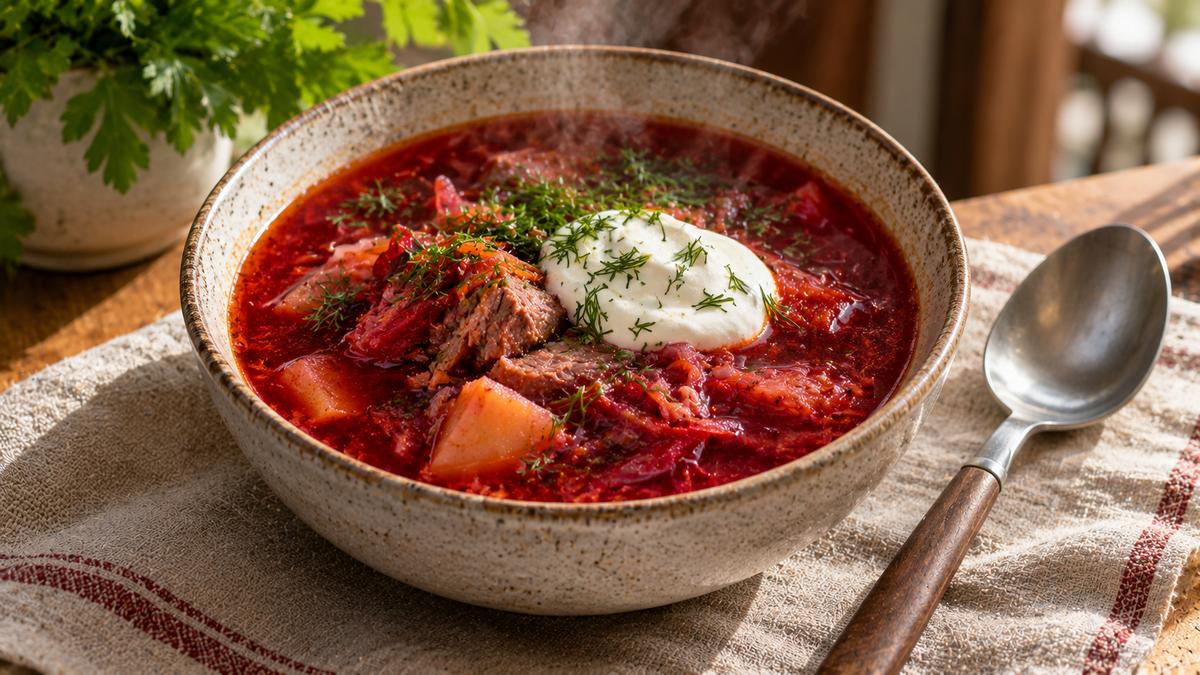
A good borshch smells of garlic and hot stock first, and only then of beetroot. You should be able to taste three things in it: sourness, the sweetness of the beets and the richness of a meat stock. If any one of them is too strong, the soup loses its balance, even when every ingredient is there. A garlic pampushka, a soft bread roll brushed with garlic, adds a punchy note of fresh garlic.
It starts with sourness
The most concise definition of borshch comes from UNESCO, and it's more precise than most recipes: a dish of stock combined with beetroot, sugar beet or fermented beetroot juice. Sourness, in other words, is built into the very definition, and in the old days it came from beet kvass, a fermented beetroot liquid.
The red colour comes from beetroot pigments called betalains. UNESCO's description also covers how it's served: borshch is cooked in a large pot and usually eaten with bread or garlic rolls. So pampushky are part of the tradition too.
Borshch by the calendar
Ukrainian tradition never had a single "correct" borshch, because what went into the pot depended on the time of year. Spring and summer meant green borshch, borshch with pork was kept for Christmas, and in autumn borshch made with mutton or chicken was popular.
That's why arguments over whether "real" borshch includes beans never get anywhere. Everyone remembers the borshch their family made when they were small.
Green, or kvaskovyi
Green borshch is also called sorrel borshch or spring borshch. In Galicia (western Ukraine), it was known as kvaskovyi borshch, or sour soup, and once again the name points to sourness, only this time it comes from sorrel.
Traditionally it took in whatever came up first in spring: young sorrel, nettles, goosefoot and beet greens. It was finished with hard-boiled egg and sour cream, or with whey or buttermilk where there was no sour cream. During Lent it was based on young nettles and early greens, and the egg was added only after Easter.
It tastes fresh and grassy, and the sourness has no beet sweetness to hide behind. If you've only had red borshch, this is an entirely different dish under a familiar name.
Borshchok and its companions
On Lviv menus, borshch is often listed alongside borshchok, a clear beetroot broth, and it rarely comes alone: it may be served with a pie, a puff pastry, a nalysnyk (a filled crêpe), pancakes or vushka.
Vushka, literally "little ears", are tiny dumplings filled with mushrooms, buckwheat or meat. In Poland and parts of western Ukraine, the borshch is poured straight over them, and mushroom vushka are especially associated with the Christmas Eve table. In both Ukraine and Poland, borshch is one of the traditional Christmas Eve dishes, and here in the west the two traditions come closest together.
If a menu lists borshchok, ask what it comes with. The answer will tell you how the kitchen treats the classics.
What changed after 2022
In 2022, the culture of Ukrainian borshch cooking was added to the list of heritage in need of urgent safeguarding. What happened next is more interesting. In 2023, UNESCO's Intergovernmental Committee, reviewing Ukraine's first report, noted that borshch had brought together people inside the country, internally displaced people and Ukrainians abroad, and had become a symbol of resilience and resistance.
What is protected is the recipe, the way it's cooked and the occasions on which one borshch or another is made. The description itself notes that borshch is celebrated in folk tales, songs and proverbs.
The modern bowl
Restaurant kitchens keep the tradition but shift the emphasis. You'll find borshch made with smoked pear and beef cheeks, borshch with prunes and smoked ribs, baked borshch with veal, and oven-cooked borshch with pork ribs. Smoked pear and prunes add smoky notes and a deep sweetness that plays nicely against the traditional sourness.
Here, too, a good borshch is easy to recognise by its balance. Sourness, sweetness and smoke should come through together, with none of them drowning out the others.
For dumplings, salo and the other dishes that sit next to borshch on the menu, read our piece on Ukrainian food.
Where to try it
To compare borshch and borshchok at one table, head to Veronica Restaurant & Confectionery, where the menu includes homemade Ukrainian borshch and borshchok with porcini vushka. Bachevski Restaurant serves a Lviv-style green borshch with potato and game crisps. Look for borshch with smoked pear and beef cheeks at Szkocka Restaurant & Bar, while Craft & Kumpel’ Beer Atelier lists a "true Galician borshch" on its menu.
If you'd like to look beyond these four places, browse our selection of Ukrainian restaurants.
Green in spring, with pork at Christmas, with vushka on Christmas Eve: borshch has its own calendar, and it's still very much in use.
Menus change, so a dish mentioned here may no longer be available. If it's the reason you're going, it's best to call ahead.